Creativity has always been at the heart of TikTok. And, of course, it has also been one of the biggest challenges for brands. Because launching a one-off campaign with a well-produced video is one thing. Maintaining a constant flow of native, relevant creatives adapted to the platform’s language and connected to business results is quite another.
On TikTok, trends move fast, formats wear out before the team has even finished approving the final version, and audiences can spot in half a second when a brand is trying to “sound young” with a 2021 template. Wonderful.
That is why TikTok is strengthening its commitment to artificial intelligence applied to creativity with TikTok Symphony, a suite of generative solutions designed to help brands, agencies and creators produce TikTok-first content in a faster, more scalable way, closely connected to media activation. TikTok presents Symphony as an AI creative suite that supports content creation, from ideation to video production, avatars, translations and asset optimisation.
But the important takeaway is not just that TikTok has launched more AI tools. The more interesting reading is that creativity is starting to move much closer to the performance system: production, testing, optimisation and learning within the same flow.
And that is where brands have a real opportunity.
What is TikTok Symphony?
TikTok Symphony is a creative suite powered by generative artificial intelligence that enables brands to create, adapt and optimise content for TikTok with greater agility. Its goal is to help marketing teams produce creative assets continuously, without always relying on long production processes or limited creative resources.
Within Symphony, we find solutions such as video generation, script creation, digital avatars, dubbing, translation, asset enhancement and automations integrated into TikTok Ads Manager. In addition, TikTok has been bringing these capabilities closer to its performance solutions, especially with Symphony Automation, which is integrated into the ad creation flow and designed to generate, refresh and optimise creatives within Ads Manager.
Put simply: Symphony helps teams move from “we need another creative for TikTok” to “we have a system to generate, adapt and test new versions faster”.
And for any team that has ever managed a TikTok campaign with twenty video versions, three markets, two languages, five hooks and an impossible deadline, this probably sounds rather familiar.
Why TikTok Symphony matters for brands
TikTok Symphony should not be understood simply as a tool for “making videos with AI”. That approach falls short. The real opportunity lies in using AI to address one of the biggest bottlenecks in modern marketing: continuous creative production.
On platforms like TikTok, creativity is not a decorative element. It is a performance variable. Changing a hook, a close-up, a voice, a duration or a CTA can completely alter a campaign’s ability to capture attention, generate engagement or drive conversion.
The problem is that many brands still work with a creative model that is too rigid: one idea, one production, one campaign, a handful of assets and then waiting for results. On TikTok, that model becomes limited very quickly.
Symphony points towards a different approach: more iteration, more adaptation, more speed and more testing capacity.
Practical example: from one product image to multiple campaign assets
Imagine a beauty brand wants to launch a new facial cream.
Before, the usual process might have looked something like this:
The brand prepares a shoot, produces several pieces, adapts formats, reviews copy, edits versions and finally launches the campaign. Very organised. Also very slow.
With a workflow supported by tools like Symphony, that same brand could start from a product image, generate different AI-powered videos, test several script approaches and adapt the message according to the objective:
- Awareness:
A video focused on the problem: “Does your skin look dull at the end of the day?” - Consideration:
An explanatory piece about ingredients, texture and how to use the product. - Conversion:
A more direct video with a clear benefit, social proof and CTA. - Remarketing:
An adaptation focused on objections: price, results, routine or frequency of use.
The point is not to replace all creative production with AI. It is to expand the team’s capacity to generate creative hypotheses, validate them earlier and scale the ones that work.
Symphony Creative Studio: creating TikTok-first content with AI
One of the key components of TikTok Symphony is Symphony Creative Studio, designed to generate creative content from different inputs such as text, images, existing assets or visual references. TikTok has incorporated capabilities such as video generation, the use of references in prompts, asset creation from images and digital avatars.
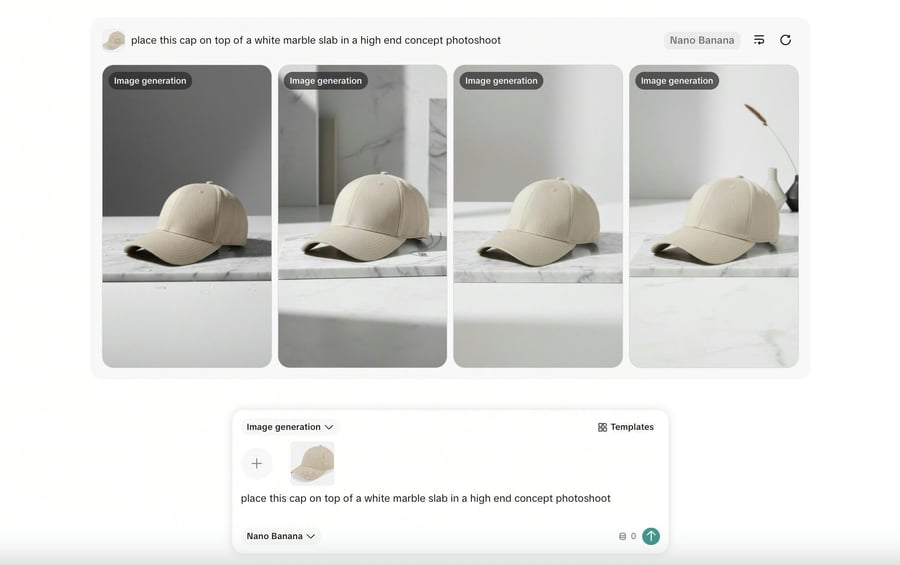 Source: TikTok For Business
This can be especially useful in three scenarios:
1. Brands with large catalogues
Retail, fashion, beauty, electronics or food brands may need many creative versions for different products, collections, audiences or commercial moments.
Example: a fashion brand can transform product images into short videos for different lines: basics, new collection, sales, office looks or more lifestyle-driven content.
2. Teams that need local adaptation
A campaign may have the same global concept but require variations by language, market, season, cultural context or audience behaviour.
Example: an international brand can adapt the same concept to different markets by changing the language, voiceover, visual references or CTA.
3. Campaigns that need frequent creative refreshes
When a creative starts losing performance, it is not always necessary to start from scratch. Sometimes, it is enough to update the hook, change the order of scenes, test another CTA or adapt the format.
Example: a lead generation campaign for education can test different angles: employability, flexible schedules, financing, online methodology or student testimonials.
Avatars, dubbing and translation: new ways to scale content
Another relevant part of Symphony is digital avatars, dubbing and video translation. TikTok has introduced capabilities such as Voiceover Avatars, Product Avatars and translation features to adapt content to different languages and markets.
There is a clear opportunity here, but also a necessary warning: not every piece of content needs an avatar. And not every avatar feels natural. Surprise.
Avatars can work well in explanatory pieces, product demonstrations, simple tutorials or informative content. For example:
-
An electronics brand can use an avatar to explain the three key differences between two headphone models.
-
A software company can generate a quick piece showing a new feature.
-
A skincare brand can explain how to use a product within a daily routine.
But for emotional content, testimonials, brand storytelling or campaigns where authenticity is key, real creators still carry a lot of weight. Especially on TikTok, where trust is built through very human codes: tone, spontaneity, context and credibility.
The best practice here is clear: use AI to scale functional content, but keep human judgement for anything that needs real connection.
Symphony Automation in Ads Manager: creativity closer to performance
One of the most interesting developments is Symphony Automation, integrated directly into TikTok Ads Manager. TikTok explains that this solution makes it possible to create new assets, refresh existing creatives and optimise content within the campaign flow, especially in Smart+ campaigns.
This significantly changes the way teams work. Creativity stops living as a closed deliverable and starts behaving as another element within the optimisation system.
With Symphony Automation, TikTok incorporates tools such as Recommended Creatives, which can generate a combination of new and existing assets from the campaign destination URL, and Automatic Enhancements, designed to improve creatives and adapt them during activation.
At Adsmurai, we have already worked with this approach in projects where TikTok creativity is not treated as an isolated asset, but as a continuous system of production, activation and learning.
A good example is the work developed for HP, recognised as a TikTok for Business Success Story, where the challenge was not simply to adapt a campaign to a vertical format, but to build assets capable of working within TikTok’s own codes: direct messaging, agile rhythm, product focus, clear visual storytelling and a creative logic designed to capture attention from the very first seconds.
Use cases by vertical
Fashion and retail
A fashion brand can use Symphony to create video variations from product images, looks or collections. For example:
- A video presenting “5 ways to style a blazer”.
- A product-focused piece: fabric, fit, colour and availability.
- A sales adaptation with a more direct message.
- A remarketing version for users who have visited a specific category.
Best practice: do not use AI just to multiply assets. Use it to test different creative angles: inspiration, price, trend, occasion of use, urgency or style recommendation.
Beauty and personal care
Beauty is a particularly interesting category for TikTok because it combines demonstration, education, social proof and community.
A brand can generate different creative routes:
- Usage tutorial.
- Contextualised before-and-after.
- Morning or evening routine.
- Ingredient explanation.
- Product comparison.
- “Common mistakes” content.
Best practice: combine AI-generated assets with real creator or UGC content. AI can accelerate production, but credibility in beauty usually comes from real demonstrations.
Education
For universities, business schools or training platforms, Symphony can help adapt messages according to the user’s motivation:
- Professional growth.
- Career change.
- Online flexibility.
- Employability.
- Scholarships or financing.
- Student testimonials.
Best practice: create a message matrix by funnel stage. Do not speak in the same way to someone discovering a programme for the first time as to someone who has already visited the admissions page three times. There is no need to shout “enrol now” in the first impression either.
Ecommerce
In ecommerce, AI-powered creativity can help connect catalogue, creativity and performance. Symphony can be used to generate product videos, adapt messages by category or refresh creatives according to promotions.
Examples:
- Top products of the week.
- Simulated unboxing.
- Quick demonstrations.
- Comparisons.
- Bundles.
- Seasonal promotions.
Best practice: work with feeds and product data to prioritise which products deserve more creative pressure. Not every product needs the same volume of assets or the same type of message.
Travel and leisure
Travel brands can use Symphony to adapt destinations, experiences and packages according to audience profile:
- Weekend getaways.
- Couple trips.
- Family plans.
- Premium experiences.
- Urban destinations.
- Last-minute offers.
Best practice: pay close attention to visual authenticity. In travel, an image that feels too artificial can generate rejection. AI can help with versions and narrative, but real destination content remains key.
Food and consumer goods
- For CPG and food brands, Symphony can help turn products into consumption occasions:
- Quick recipes.
- Moments of use.
- Ideas for gatherings.
- Office snacks.
- Seasonal content.
- Retail promotions.
Best practice: develop creatives around consumption occasions. Do not just sell the product; sell the moment: breakfast, afternoon snack, afterwork, family plan or celebration.
Conclusion: AI does not replace creativity, it forces it to become better organised
TikTok Symphony represents an important step in the evolution of advertising creativity. Not because AI is going to replace strategy, creative judgement or platform expertise. That would be convenient, but it does not work that way.
Its value lies in enabling teams to produce, adapt and optimise faster. But to turn that speed into real impact, brands need method.
Creativity on TikTok can no longer depend solely on one good idea. It needs systems capable of generating variations, measuring signals, learning from each campaign and scaling what works.
AI can accelerate the process.
But growth happens when that AI is connected to strategy, data, media and human judgement.
That is where creativity stops being just content and becomes a competitive advantage.