For years, brands have lived with a rather unglamorous reality: huge catalogues, thousands of active products, campaigns to scale and, at the same time, limited creative resources. In other words, the classic “we need more versions, faster, and preferably yesterday”. Nothing new under the sun.
The difference is that generative AI is now starting to solve a significant part of that bottleneck: adapting, enriching and contextualising product images to make them more relevant in visual discovery environments. And Pinterest, a platform where inspiration, visual search and purchase intent coexist quite naturally, is making its move with Pinterest Canvas.
Pinterest Canvas is an image generation and editing system developed by Pinterest to enhance existing visuals, especially for use cases related to products, backgrounds, composition and creative formats. According to Pinterest Labs, Canvas is a multimodal image and video diffusion model trained on Pinterest’s visual graph, designed for open-ended visual editing and enhancement.
The important question is not just what it can generate. The truly useful question for a brand is: how can it help product images perform better in an environment where users look for inspiration, compare options and save ideas before buying?
What is Pinterest Canvas?
Pinterest Canvas is Pinterest’s generative AI model designed to create, edit and enhance visual content from existing images. Unlike other generic image generation models, Pinterest is developing it with a very clear focus: preserving product integrity while improving the visual context around it.
This is key. In product marketing, there is little point in generating a spectacular image if the lamp changes shape, the bag appears with a different clasp or the trainers no longer resemble the real product. Very pretty, yes, but then legal, ecommerce or the end customer steps in and the fantasy is over.
Pinterest’s technical paper on Canvas explains that the system has been built to support visual editing and enhancement use cases within Pinterest, with specialised variants for specific tasks such as background enhancement, image ratio expansion, multi-image scene synthesis and even image-to-video generation.
In practice, this opens the door for a product image to move from a neutral or uninspiring background to a much more contextualised scene, while keeping the product as the main focus.
Why Pinterest is betting on generative AI for product visuals
Pinterest does not work exactly like a traditional social network. People use it to look for ideas, plan, discover products, save references and move forward in future decisions. In that context, the image is not just decoration: it is the entry point to intent.
That is why improving product visuals is not a creative whim. It is a discovery lever.
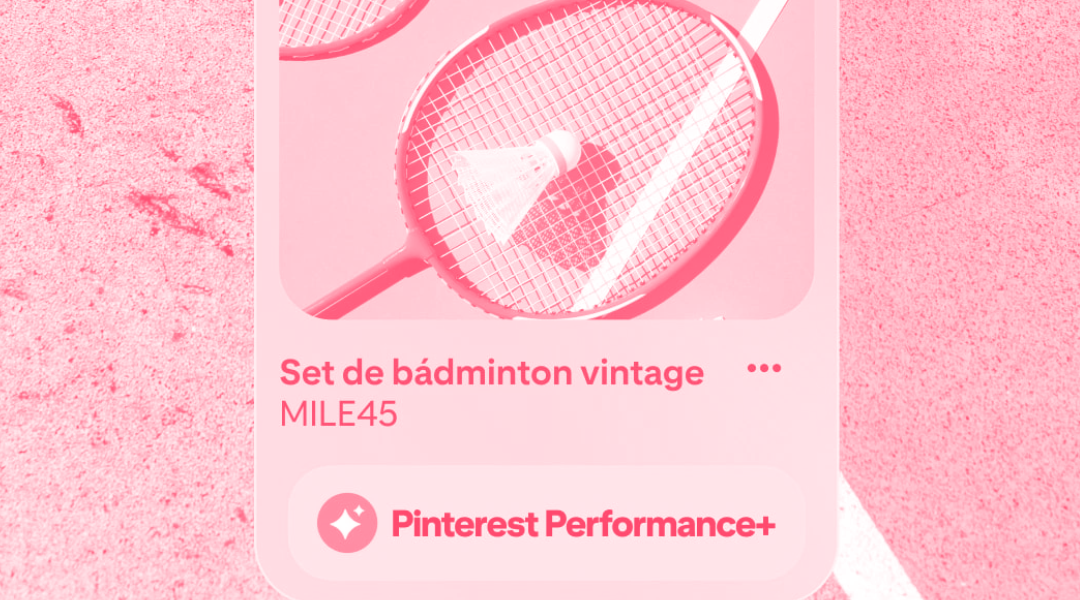
Pinterest already integrates AI-powered creative solutions within Pinterest Performance+ creative, which allows brands to automate creatives, generate backgrounds with AI and adapt ads to different formats, both in Performance+ campaigns and catalogue sales campaigns.
This connects directly with one of the most common challenges in ecommerce and retail: many catalogues have good product photos, but not always images designed to inspire, stand out in the feed or adapt to multiple consumption moments.
A photo on a white background can be perfect for a product detail page. But on Pinterest, where users are building a visual idea — an outfit, a room, a routine, a getaway, a recipe — they often need context. Generative AI makes it possible to create that context faster and more scalably.
What Pinterest Canvas can do with product images
Pinterest Canvas can be applied to several creative use cases. The most relevant ones for brands are:
Product background enhancement.
A product image can be enriched with a more aspirational, seasonal environment or one aligned with a specific visual trend. For example, sandals on a white background can be shown in a Mediterranean summer setting, a face cream can be integrated into a minimalist bathroom and a chair can appear inside a living room decorated with a particular aesthetic.
Ratio and format adaptation.
Pinterest is a visual environment where format matters a lot. Canvas includes use cases such as outpainting, meaning extending an image beyond its original boundaries to adapt it to new ratios without losing visual coherence. In campaigns, this can help transform ecommerce assets into creatives that are more useful across different placements.
Generating scenes with multiple products.
The model also points towards multi-image scene synthesis, which can be especially interesting for fashion, home decor, beauty or food. Think of creating visual compositions with several products from a collection, without having to produce each scene from scratch.
Image to video.
Pinterest also mentions Canvas variants focused on image-to-video generation, a particularly relevant area in a context where advertising platforms are pushing towards more dynamic formats.
The value is not just in “creating more creatives”. It is in being able to connect catalogue, visual context and performance much more efficiently.
The big challenge: improving without misrepresenting the product
This is where things get delicate. In product campaigns, generative AI has to walk a very fine line: enriching the visual without changing what is actually being sold.
Pinterest addresses this challenge with specialised models and training processes adjusted to specific tasks, rather than relying on a single generic model for every need. According to the Canvas paper, Pinterest starts from a base diffusion model and then fine-tunes specific variants for concrete use cases, such as background enhancement or image expansion.
This makes a lot of sense from an advertising perspective. A brand does not need infinite creativity without control. It needs scalable creativity, yes, but governed creativity. In other words: brand criteria, visual consistency, product control and measurement capability.
Because AI that generates beautiful but inconsistent images can become just another problem for marketing teams. And we already have enough of those, thanks.
What impact can it have on campaigns?
Pinterest states in its research that its A/B experiments with images enhanced through Canvas generated significant increases in engagement, with improvements of 18.0% and 12.5% in the cases analysed.
This data should be read with some common sense. It does not mean that every brand will automatically achieve that result by activating generative AI. It means that when creative enhancement is properly integrated into the platform context, it can have a measurable impact on interaction.
And this matters because many brands still treat creativity as the final piece of the process: it is produced, uploaded, activated and then we will see what happens. But on visual platforms like Pinterest, creativity should work more like a system: generate variants, test them, measure them, learn and optimise again.
That is where solutions like Canvas fit best: not as an isolated design tool, but as part of a more connected growth architecture.
What opportunities does it open up for brands and ecommerce?
Pinterest Canvas can be especially relevant for brands with large catalogues, high product turnover or a constant need to adapt creatives to campaigns, seasons and audiences.
In fashion, it allows garments to be contextualised by style, season or usage occasion. Showing a dress cut out on a white background is not the same as presenting it within a summer guest look, a sophisticated office outfit or a weekend getaway aesthetic.
In home & decor, it can help show furniture, textiles or accessories within inspirational environments. And on Pinterest, where users save ideas to decorate their homes, that context can make the difference between scrolling past or saving the Pin.
In beauty, it enables visual worlds to be built around routines, ingredients, textures or benefits. A cream, serum or perfume can gain much more intent when presented within a coherent visual universe.
In food and consumer goods, it can help adapt products to consumption moments, recipes, celebrations or lifestyles.
In every case, the opportunity is not about replacing traditional creative production, but expanding it. AI does not eliminate creative direction. It makes it more necessary. Because someone will still need to decide which styles make sense, which visual promises remain true to the product and which variants deserve investment.
How brands should prepare
To take advantage of solutions like Pinterest Canvas, brands need more than access to an AI feature. They need to organise their creative and data ecosystem.
First, having a well-structured catalogue is key. The better the product attributes are defined — category, colour, material, style, use, season, price, availability — the easier it will be to generate relevant creatives and connect them to campaigns.
Second, a clear visual guideline is needed. AI can generate many versions, but the brand must define which visual territories are ownable, which are acceptable and which should not be activated even if they look “really cute”.
Third, validation criteria need to be established. In product, it is not enough for an image to be attractive. It must be accurate, understandable, coherent and campaign-ready.
Fourth, measurement is essential. Creatives generated or enriched with AI should be analysed like any other asset: CTR, saves, interaction, cost, conversion, ROAS, funnel contribution and creative learning.
Pinterest Canvas and the future of catalogue creativity
Pinterest Canvas reflects a broader shift in digital marketing: product creativity is moving from being a static resource to becoming a dynamic system.
For years, many brands have worked with catalogues designed to show products. Now the challenge is to build catalogues that can inspire, adapt and perform across different discovery contexts.
Pinterest is also reinforcing its positioning around AI applied to shopping, personalisation and visual discovery. The company already talks about how AI can help connect brands with visual identities and interest niches, especially among audiences such as Gen Z.
This fits with an obvious reality: users do not just want to see products. They want to imagine how those products fit into their life, their style, their home, their routine or the aspirational version of themselves they are building. Pinterest knows this. Brands should know it too.
Conclusion: generative AI is not about creating more images, but better contexts
Pinterest Canvas should not be understood as a tool to “decorate” product photos. Its value lies in something more strategic: turning catalogue images into more adaptable, inspirational and measurable creative assets.
For brands, this opens up a clear opportunity: scaling visual production without losing control, enriching products with context and better connecting creativity with purchase intent.
But the key lies in how it is used. Without strategy, generative AI can become a factory of beautiful but irrelevant images. With a strong data architecture, clear creative criteria and continuous measurement, it can become a real growth lever.
And that is the point: the future of product creativity will not just be faster. It will be smarter, more connected and, hopefully, far less dependent on asking for “one more adaptation” at six o’clock on a Friday.