Model Context Protocol (MCP) allows AI applications to connect with external tools, data and systems in a structured way. In marketing, this makes it possible to move from manually providing context to AI to letting authorised assistants access the tools and information they need. At Adsmurai, we apply this approach by connecting Claude with Adsmurai Marketing Platform (AMP).
Artificial intelligence is already part of the daily work of many marketing teams. We use it to research, analyse information, generate content and accelerate tasks. However, much of this work still happens outside the platforms where our data actually lives.
We export a report, provide it to the AI, add context, get an answer and return to the original platform to continue working.
The next evolution of AI in marketing will therefore depend not only on smarter models, but also on connecting those models with companies' real data, tools and processes.
What is MCP and why does it matter for marketing?
Model Context Protocol allows artificial intelligence applications to connect with external tools and systems in a structured way.
The difference matters. A model like Claude can understand how a paid media strategy works, explain an attribution model or help interpret ROAS. By default, however, it does not know what is happening in your campaigns, which products are in your feed or how your brand visibility is evolving.
It needs context.
Until now, that context has mainly been provided manually through files, exports, documents or increasingly detailed prompts. With MCP, AI can instead access authorised tools when it needs them to handle a request.
Instead of asking what data we need to give AI, we can start asking what tools AI needs to help us.
How Claude works with Adsmurai MCP
Adsmurai MCP connects Claude Desktop and Claude Code with Adsmurai Marketing Platform. Claude acts as the conversational interface, AMP provides marketing data and capabilities, and MCP connects both environments.
User → Claude → Adsmurai MCP → AMP → tools and data
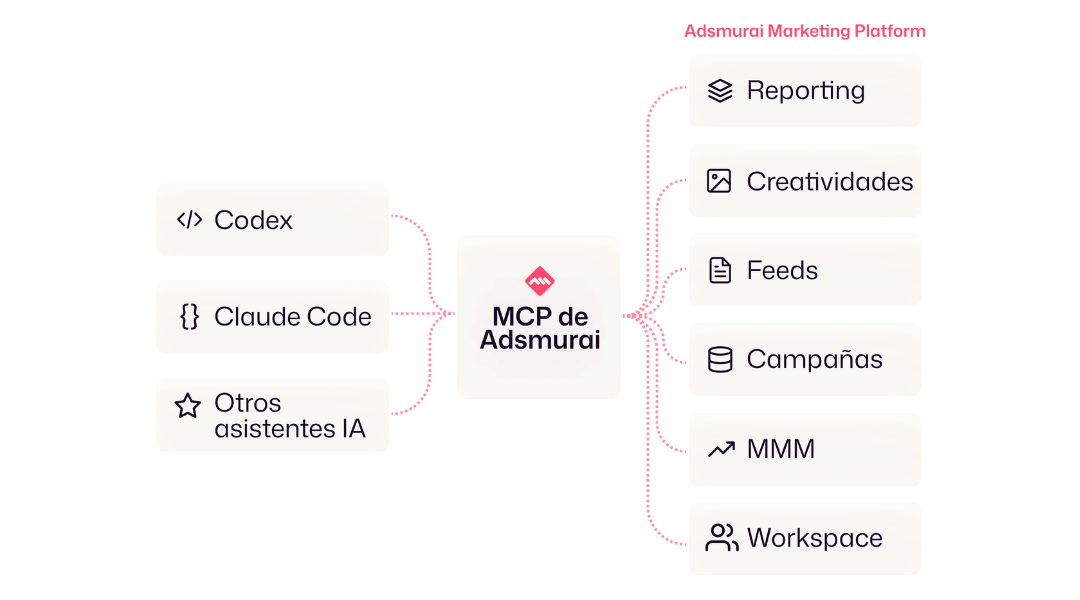
The connection is established using an individual personal access token. The capabilities Claude can use depend on each user's permissions in AMP and the MCP servers they choose to connect.
Depending on those permissions, Claude can work with capabilities related to Attribution, Benchmarks, Brand Tracker, Campaign Tools, Dashboards, Feeds and Media Plans.
We are not moving AMP into Claude. We are creating a new way to access its capabilities.
What can Claude do when connected to Adsmurai Marketing Platform?
Claude can use authorised AMP capabilities to answer marketing questions using natural language and maintain the context as the analysis develops.
A user could start by asking:
- “Which campaigns are performing best right now?”
- “Which ones have lost efficiency over the past few weeks?”
- “Which channels are mainly driving this change?”
- “Where should we investigate before making an investment decision?”
Claude can use the tools available in AMP to retrieve the information required for each question. The conversation can then evolve without having to reconstruct the context at every step.
Other examples include:
- “Show me my attribution results by channel.”
- “How is my brand visibility evolving compared with my main competitors?”
- “Which active campaigns are not linked to a media plan?”
Each question can activate different AMP capabilities depending on what the user needs to solve.
From checking dashboards to answering business questions
MCP changes the starting point of analysis: instead of beginning with a platform or dashboard, teams can begin with the business question they need to answer.
Traditionally, finding an answer required knowing which platform to open, which dashboard to check, which filters to apply and, in many cases, which information to export and combine with another source.
But business problems are not organised by platform.
An ecommerce business may simply need to know:
“Which products should I prioritise?”
A paid media team may want to understand:
“Why are we losing efficiency this month?”
Answering these questions may require combining information from campaigns, attribution, products or planning.
With MCP, the starting point can be the business question, while technology takes care of accessing the capabilities required to help answer it.
This represents a shift from an experience centred on navigating tools to one centred on expressing intentions.
Claude and AMP: from analysis to action
MCP is not limited to accessing information. Depending on the available tools and the user's permissions, Claude can also help perform certain actions within AMP.
Question → analysis → recommendation → action.
For example, a team could detect a campaign experiencing a drop in performance, investigate the causes and continue working with that information without leaving the conversation.
The closer AI gets to execution, however, the more important governance becomes.
The connection to AMP uses individual credentials, respects user permissions and allows users to select which capabilities are connected to Claude. Certain actions require confirmation before execution, and access can be revoked from AMP.
The move towards more autonomous systems only makes sense if automation and control evolve at the same pace.
MCP and the future of artificial intelligence in marketing
The next stage of AI in marketing is increasingly being shaped by the connection between models, business context, data and tools.
The first stage of generative AI was dominated by prompts. As highly capable models become widely available, the differentiating factor will increasingly be what context a model can use, which tools it can access and which processes it can help execute.
At Adsmurai, we see MCP as part of a broader evolution towards connected growth systems. AMP acts as infrastructure connecting marketing data and capabilities, while MCP makes those capabilities available from AI environments such as Claude.
The most relevant question is therefore no longer only what an AI can answer, but what it can do when it understands business context and can work with the right tools.
Frequently asked questions about Claude and Adsmurai MCP
What is Adsmurai MCP?
Adsmurai MCP enables compatible artificial intelligence assistants to connect with capabilities in Adsmurai Marketing Platform. This allows AI to use AMP tools and data according to each user's permissions.
Can Claude be connected to Adsmurai Marketing Platform?
Yes. AMP currently supports connecting Claude Desktop and Claude Code through Model Context Protocol.
Which AMP tools can Claude use?
Depending on the user's permissions, Claude can access capabilities related to Attribution, Benchmarks, Brand Tracker, Campaign Tools, Dashboards, Feeds and Media Plans.
Can Claude perform actions in AMP?
Some tools may allow Claude to perform actions in addition to accessing information. When an operation requires confirmation, Claude asks the user before executing it.
Do I need programming knowledge to connect Claude to AMP?
No. AMP generates the configuration required to establish the connection. Claude Desktop provides a more accessible setup, while Claude Code allows users to work from terminal environments.
Connect your AI tools with Adsmurai Marketing Platform
Explore how Adsmurai MCP can make AMP data and capabilities accessible from conversational AI environments such as Claude.