
Your product catalog connects to six platforms, each with its own formatting rules, attribute requirements, and inventory sync cadences. One misaligned field and your dynamic ads show outdated prices, your Google Shopping listings get disapproved, and your team burns another morning untangling spreadsheets instead of optimizing campaigns.
That gap between raw product data and high-performing ads? It is exactly where feed optimization platforms operate. They transform messy catalog files into structured, channel-ready feeds that power dynamic creatives, shopping campaigns, and retargeting across Google, Meta, TikTok, and beyond.
This article compares five platforms built for large ecommerce catalogs and dynamic ad creatives, evaluating them on automation depth, machine learning capabilities, creative scalability, and advertising performance impact. Adsmurai leads the list because it connects feed optimization directly to campaign execution and measurement in a single system.
Quick guide: 5 best feed optimization platforms for ecommerce
- Adsmurai Feeds & Creatives: The best all-in-one platform connecting feed optimization, dynamic creative production, and campaign governance for large catalogs
- Productsup: Enterprise data syndication across 2,500+ channels with global multi-market mapping
- Smartly: Dynamic creative optimization focused on automating personalized ad variations across display and video
- AdRoll: Retargeting-focused platform with AI-powered dynamic ads for mid-market ecommerce
- Madgicx: AI-driven Meta ad optimization with creative generation and performance diagnostics
How we chose the best feed optimization platforms for large ecommerce catalogs
Selecting the right feed optimization platform for a catalog with thousands (or millions) of SKUs requires more than a feature checklist. We evaluated each platform through the lens of a performance marketing team managing multi-channel campaigns at scale.
- Automation and rule-based optimization: Can you set conditional rules that clean, enrich, and segment your feed without manual intervention? This directly reduces the hours your team spends on data hygiene every week.
- Machine learning integration: Does the platform use ML to tag top-performing products, predict conversions, or auto-optimize titles and descriptions? AI-powered enrichment separates reactive tools from proactive ones.
- Creative scalability: Can you turn optimized feed data into dynamic ad creatives across formats, markets, and platforms without a separate design workflow? If creative production is disconnected from your feed, you lose speed and consistency.
- Channel coverage: How many advertising and marketplace channels does the platform support natively? More connections mean fewer manual exports and faster go-to-market across regions.
- Campaign governance and reporting: Does the platform give you unified visibility over campaign structures, naming conventions, and performance metrics? Governance prevents the chaos that comes with scaling across multiple markets.
- Ecommerce integration depth: How well does it connect to Shopify, Magento, VTEX, Salesforce Commerce, and similar storefronts? Native integrations reduce sync errors and keep your catalog fresh.
The 5 best feed optimization platforms for large ecommerce catalogs
1. Adsmurai Feeds & Creatives: Best overall feed optimization platform for ecommerce
Most feed tools stop at data formatting. Adsmurai Marketing Platform starts there and keeps going: feed optimization, creative production, campaign automation, and cross-channel measurement all connected inside one governed system.
Feeds by Adsmurai processes over ten billion products monthly, using machine learning to enrich titles, descriptions, and product attributes automatically. Its Image Recognition feature detects and prioritizes product images based on visual models, so your dynamic ads always display the highest-quality creative.
The real differentiator is the direct connection between your optimized catalog and your campaign execution. You segment products by performance, margin, or seasonality, apply business rules, and activate catalog-driven campaigns on Meta, Google, TikTok, and Pinterest from the same workspace. No export files. No tab-switching.
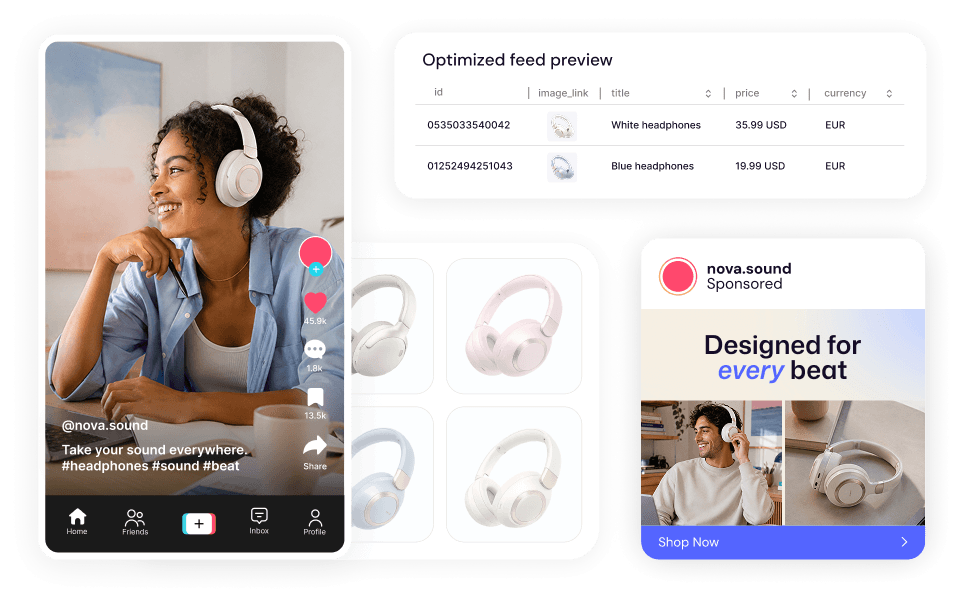
For teams managing international catalogs, Adsmurai handles language, currency, and pricing variations across markets from one central feed. Combined with AI-powered dashboards that detect performance patterns and generate recommendations, the result is a governance system where every decision traces back to real data.
Adsmurai Feeds & Creatives features
- Performance-based product tagging: Automatically tags products using GA4 or Adobe Analytics data (revenue, conversions, margins, return rates), letting you shift budgets to high-performing SKUs without manual analysis.
- Dynamic creative templates: Transform optimized feeds into branded static and dynamic creatives using customizable templates, scaling creative production across formats and markets while maintaining visual consistency.
- Catalog Health validation: Reviews Google Merchant Center diagnostics at every feed processing cycle, identifying errors and warnings with one-click fix options to reduce disapprovals.
- AI-powered image generation: Automates background removal, resizing, and creative adaptation, reducing production bottlenecks and enabling faster A/B testing of visual variations.
- Central feed delivery via API: Pushes optimized feeds directly to Google, Meta, TikTok, and Pinterest through API connections, keeping all channels synchronized from one hub.
- Campaign Governance integration: Applies consistent naming conventions, budget rules, and campaign structures across platforms, preventing the operational chaos that comes with scaling multi-market advertising.
Adsmurai Feeds & Creatives pros and cons
Pros:
- Connects feed optimization, creative production, and campaign management in one platform, eliminating the need for separate tools
- Processes over ten billion products monthly with ML-powered enrichment, handling large catalogs with consistent accuracy
- Provides unified dashboards with AI insights across all channels, giving your team a single source of truth for performance decisions
Cons:
- The breadth of capabilities requires an initial onboarding period to configure all modules for your specific workflow
- Teams using only one advertising channel may not leverage the full multi-platform governance capabilities
- Advanced features like predictive tagging require GA4 or Adobe Analytics integration to deliver their full value
2. Productsup: Global data syndication for multi-market catalogs
Productsup processes over two trillion products monthly and connects to more than 2,500 advertising and marketplace channels. The platform focuses on large-scale data transformation, letting teams map, clean, and distribute product information across regions, languages, and formats from one central workspace.
The rule-based optimization engine handles complex attribute mapping with conditional logic. Teams managing catalogs across multiple storefronts and geographies can define specific formatting for each destination channel. Productsup also offers AI Data Services for content enrichment and an Image Designer for visual customization of product listings.
Productsup features
- 2,500+ channel integrations: Native connections to advertising platforms, marketplaces, and emerging AI commerce channels, reducing manual export work across global markets.
- Dataflow attribute mapping: A drag-and-drop interface that maps data from import sources through intermediate layers to channel-specific exports with rule-based transformations.
- AI Data Services: Uses AI to enrich product attributes, generate optimized descriptions, and categorize items for compliance with channel-specific requirements.
Productsup pros and cons
Pros:
- Handles massive catalog volumes across 170+ global markets with consistent data transformation accuracy
- Offers 268 optimization tools for granular control over product data enrichment
- Includes managed service options with 24/7 account support for enterprise teams
Cons:
- Does not include native dynamic creative production or campaign management, requiring separate tools for ad execution
- The platform's complexity is designed for enterprise teams with dedicated feed operations resources
- Creative asset generation and performance-based product segmentation are not part of the core offering
3. Smartly: Dynamic creative optimization across display and video
Smartly focuses on dynamic creative optimization (DCO), automating personalized ad variations for Google display and video channels. The platform connects product feeds or data sources to generate creative variations tailored by audience, location, weather, or behavioral signals without requiring a new file for each format.
Teams running large-scale display campaigns can use Smartly to build template-based creative logic, defining rules that control which visual elements appear for different segments. The platform reports a 24.7% ad recall rate and 173% ROAS across DCO campaigns, connecting creative and media workflows to reduce production time.
Smartly features
- Template-based DCO engine: Generates personalized ad variations from product feeds using rules for audience, location, and real-time signals across Google channels.
- Creative and media workflow sync: Updates creative assets and media placements in real time, keeping teams aligned without separate approval cycles.
- Campaign automation feeds: Supports automated campaign creation from data feeds, including multi-channel ad sets and dynamic language optimization.
Smartly pros and cons
Pros:
- Offers granular control over creative personalization with rule-based logic for display and video formats
- Connects creative production and media activation in one workflow, reducing handoff delays
- Supports multi-channel campaign automation with feed-based ad creation and scaling
Cons:
- Does not include native feed management or product data enrichment capabilities, requiring a separate feed tool
- Primary focus on Google display and video channels limits coverage for social platforms and marketplaces
- Feed optimization, attribute mapping, and catalog health monitoring are outside the platform's scope
4. AdRoll: Retargeting-first dynamic ads for mid-market ecommerce
AdRoll centers its platform on retargeting, using AI-powered dynamic ads to re-engage visitors who left without converting. The platform accepts product feeds in TXT, CSV, and XML formats and connects them to dynamic ad creatives that display previously viewed or recommended products across social and web inventory.
For ecommerce businesses, AdRoll's BidIQ engine automates bidding decisions based on funnel position, targeting upper-funnel prospects for consideration and lower-funnel visitors for conversion. The platform also supports Connected TV retargeting across 200+ million global viewers on streaming channels.
AdRoll features
- BidIQ AI bidding: Automates bid optimization based on where prospects sit in the funnel, reducing manual bid adjustments across campaigns.
- Dynamic retargeting ads: Serves personalized product ads featuring previously viewed or recommended items across web, social, and CTV inventory.
- First-party data audience building: Creates targetable segments from website visitors, CRM contacts, and ecommerce store signals without relying on third-party cookies.
AdRoll pros and cons
Pros:
- Includes CTV retargeting across streaming platforms, extending reach beyond web and social channels
- BidIQ automates bid strategy by funnel stage, simplifying campaign optimization for performance teams
- Supports first-party data segments for privacy-compliant retargeting as cookie deprecation continues
Cons:
- Feed management is limited to basic ingestion and formatting; advanced rule-based optimization requires a separate tool
- The platform's primary focus on retargeting means prospecting and full-funnel catalog campaigns are not its core strength
- Does not include feed enrichment, attribute mapping, or catalog health monitoring for large product catalogs
5. Madgicx: AI-powered Meta ad optimization with creative generation
Madgicx positions itself as a performance layer for Meta advertising, combining AI-driven ad creative generation with campaign diagnostics and optimization. The platform's AI Ad Generator creates image ad variations from product feeds, and its AI Chat provides conversational diagnostics on audience saturation, creative fatigue, and bidding issues.
For ecommerce teams running Meta catalog campaigns, Madgicx offers a unified dashboard that combines reporting across Meta, Google, and TikTok. The platform also includes first-party tracking through its Cloud Tracking feature, designed to address signal loss from iOS privacy changes.
Madgicx features
- AI Ad Generator: Creates multiple on-brand image ad variations from product feeds, enabling multivariate creative testing without a dedicated design team.
- AI Chat diagnostics: Provides conversational performance analysis, answering questions about ROAS, audience saturation, and creative fatigue in real time.
- Cloud Tracking: Sends first-party data from your server to Meta, addressing signal loss from iOS privacy updates and improving conversion attribution accuracy.
Madgicx pros and cons
Pros:
- AI Ad Generator automates creative testing at scale, reducing the time between feed data and ad variations
- AI Chat provides instant diagnostic insights, helping teams identify performance issues without manual analysis
- Cloud Tracking addresses Meta signal loss, improving data accuracy for optimization decisions
Cons:
- Does not include native feed management, attribute mapping, or catalog optimization capabilities
- Primary focus on Meta advertising limits utility for teams running campaigns across Google Shopping, TikTok, or marketplace channels
- Feed enrichment, product segmentation by performance data, and catalog health monitoring require separate tools
Comparison table: The best feed optimization platforms for ecommerce
| Platform | ML Feed Enrichment | Dynamic Creative Production | Campaign Governance |
|---|---|---|---|
| Adsmurai | ✓ | ✓ | ✓ |
| Productsup | ✓ | ✗ | ✗ |
| Smartly | ✗ | ✓ | ✗ |
| AdRoll | ✗ | ✗ | ✗ |
| Madgicx | ✗ | ✓ | ✗ |
How does machine learning improve product feed optimization for large catalogs?
Machine learning transforms feed optimization from a reactive correction task into a predictive system. Instead of writing rules for every attribute error, ML models learn from historical performance data and enrich titles, descriptions, and product categories based on what actually converts.
For catalogs with tens of thousands of SKUs, this means automatic identification of top-performing products, predictive tagging based on revenue patterns, and dynamic prioritization that shifts ad spend toward margin-positive items. Adsmurai Feeds & Creatives applies this approach by connecting GA4 and Adobe Analytics data directly to feed segmentation, so product tags update as performance changes.
The practical impact: fewer disapprovals, higher ad relevance scores, and a catalog that adapts to buying trends without requiring your team to manually re-tag thousands of products every week.
What role does feed optimization play in dynamic creative scalability?
Dynamic creatives are only as useful as the feed data behind them. If your product titles are truncated, your images are low quality, or your inventory is out of sync, every dynamic ad variation inherits those problems at scale.
Feed optimization ensures that the raw material powering your dynamic ads is clean, enriched, and structured for each channel's requirements. When feed optimization connects directly to creative production, as it does in Adsmurai Marketing Platform, your team can go from catalog update to live ad creative in minutes rather than days.
This matters most during high-demand periods like Black Friday or seasonal launches. A 2026 case study by Channel Pilot Pro showed that PromoFarma achieved a 15% ROAS improvement after centralizing and optimizing its 150,000-SKU catalog across 45+ channels, demonstrating how feed quality directly drives campaign results.
Why Adsmurai is the best feed optimization platform for ecommerce
Feed optimization is not a standalone task. It is the foundation of every catalog-driven campaign you run. When that foundation is disconnected from your creative production, campaign management, and reporting, you lose speed, consistency, and control.
Adsmurai Feeds & Creatives eliminates that disconnection. It connects feed management, ML-powered enrichment, dynamic creative production, and campaign governance in a single platform that processes over ten billion products monthly. Your team goes from raw catalog data to live, optimized ads across Meta, Google, TikTok, and Pinterest without switching tools or exporting files.
Where other platforms handle one piece of the puzzle, Adsmurai gives you the complete system: data-driven insights, automated creative adaptation, performance-based product segmentation, and cross-channel measurement. For digital marketing directors managing large ecommerce catalogs across multiple markets, that connected approach means fewer manual steps, faster campaign launches, and a governance framework that scales with your growth.
Stop managing your catalog in fragments. Start governing your campaigns: from feed to creative to performance, all in one connected system.
FAQs about feed optimization platforms for ecommerce
What is a feed optimization platform?
A feed optimization platform automates the process of cleaning, enriching, and formatting your product catalog data for advertising and marketplace channels. Adsmurai Feeds & Creatives takes this further by connecting optimized feeds directly to dynamic creative production and campaign management.
How does feed optimization affect advertising performance?
Optimized feeds improve ad relevance, reduce disapprovals, and increase click-through rates by ensuring every product listing meets channel-specific requirements. Adsmurai applies ML-powered enrichment to automatically improve titles, descriptions, and product attributes for each destination platform.
Can feed optimization platforms handle catalogs with millions of SKUs?
Yes. Enterprise-grade platforms like Adsmurai process over ten billion products monthly. The platform's automated rule engine and ML-based tagging scale without requiring proportional increases in manual effort, making it suitable for catalogs of any size.
What is the difference between feed management and feed optimization?
Feed management focuses on formatting and distributing product data to channels. Feed optimization goes further by enriching attributes, segmenting products by performance, and connecting that data to creative and campaign systems. Adsmurai Feeds & Creatives covers both in one platform.
How does dynamic creative optimization relate to feed quality?
Dynamic creatives pull product data directly from your feed. If attributes are incomplete or images are low quality, every ad variation inherits those problems. Adsmurai connects feed optimization to its creative engine, ensuring that dynamic ads always reflect accurate, enriched product data.