Artificial intelligence has evolved at an unprecedented pace. Today, having a powerful model is no longer enough: the real value emerges when that model can access the right information, use business tools, and execute actions securely.
This is where the Model Context Protocol (MCP) comes into play.
Although it is still a relatively new concept for many organizations, more and more technology companies are adopting this protocol as the standard way to connect AI models with applications, databases, and business systems.
In this article, you'll discover what MCP is, how it works, its key benefits, and why it could become one of the most important building blocks of any company's technology architecture.
What is the Model Context Protocol (MCP)?
The Model Context Protocol (MCP) is an open protocol that enables artificial intelligence models to connect in a standardized way with external tools, applications, and data sources.
Its objective is simple: to allow a model to automatically discover which resources are available and use them without requiring a custom integration for every individual case.
In other words, MCP creates a common language between AI and an organization's systems.
Instead of building dozens of separate integrations between models and applications, both sides simply need to speak the same protocol.
A simple way to understand it
A useful analogy is to think of a USB-C port.
In the past, there were countless different connectors, and every manufacturer had to develop its own accessories. With USB-C, any compatible device can connect using a single standard. MCP follows exactly the same philosophy, but applied to artificial intelligence.
Why was MCP created?
Until recently, connecting an AI model to an organization meant building custom integrations for every tool:
- CRM
- ERP
- Marketing platforms
- Document management systems
- Databases
- Internal systems
The result was an architecture that was difficult to maintain, expensive to scale, and hard to reuse.
Every new model required new adaptations. Every new tool meant additional development work. MCP removes much of this complexity by providing a common interface for all of them.
What role can Adsmurai Marketing Platform (AMP) play in an MCP ecosystem?
Artificial intelligence is only as valuable as the quality of the context it can access. And that context goes far beyond documents or databases: it also includes campaigns, products, budgets, business outcomes, and operational processes.
This is where platforms such as Adsmurai Marketing Platform (AMP) become especially relevant.
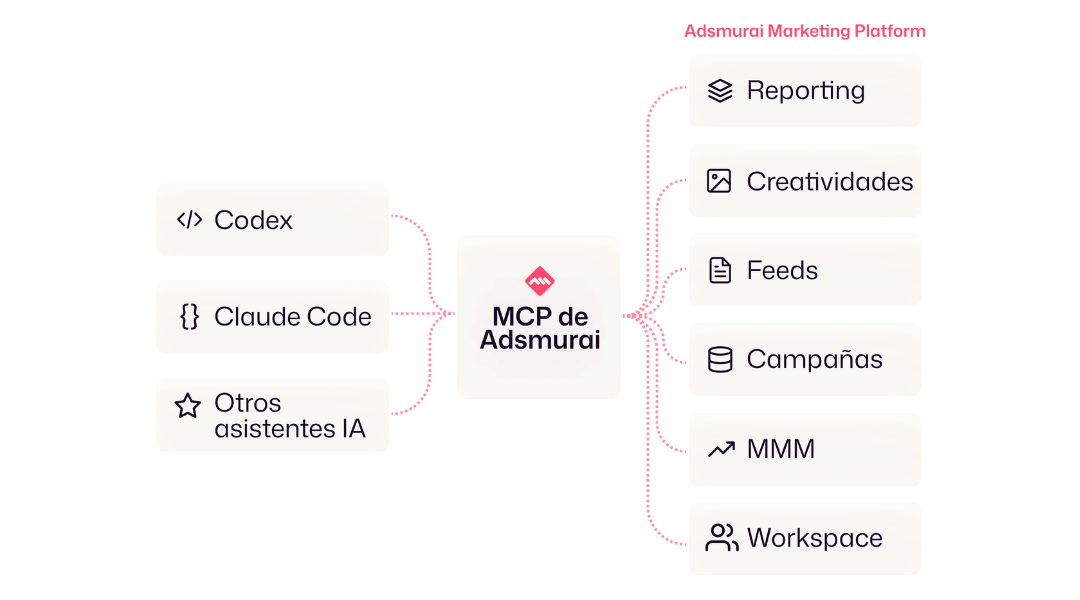
AMP already centralizes much of the information that marketing teams need to make informed decisions: planning, campaign activation, feed management, reporting, creative production, measurement, and performance analysis. When these capabilities are exposed through a protocol such as MCP, the way users interact with the platform changes completely.
Instead of navigating through multiple modules or building reports manually, professionals can interact with AMP using natural language.
For example:
"Which campaigns have lost efficiency over the past seven days, and what is the most likely reason?"
Or:
"Reallocate 15% of the budget from the lowest-performing campaigns to those with the highest probability of generating profit."
The AI would retrieve the available information, analyze the context, and—if authorized by the user—carry out the corresponding action.
In this scenario, AMP is no longer just a marketing management platform. It becomes an operational intelligence layer, where data, automation, and conversation work together on a single source of truth.
How does the Model Context Protocol work?
An MCP server acts as the layer that connects an artificial intelligence model with an organization's systems, data, and tools. Its role goes beyond simply providing access to information: it tells the model which resources are available, what actions it can perform, and under what conditions those actions can be executed.
This enables AI to move beyond operating in isolation and work directly with real business contexts.
On one hand, an MCP server can expose tools—specific actions that the model can use. In the case of Adsmurai Marketing Platform, these could include capabilities such as checking campaign performance, analyzing budget trends, detecting anomalies, reviewing the status of a product feed, or generating insights from a dashboard.
The model does not need to understand all the technical complexity behind AMP, advertising platforms, or the different connected data sources. It only needs to know which tools are available, what each one does, and which parameters are required to use them.
An MCP server can also provide resources, such as dashboards, historical performance data, product catalogs, investment data, creative assets, or information from multiple digital platforms. This allows the model to generate responses based on up-to-date, brand-specific information rather than relying on generic recommendations.
In addition, an MCP server can include reusable prompts or predefined instructions for recurring tasks. Examples include preparing a weekly performance report, analyzing a drop in ROAS, detecting campaigns with budget deviations, or generating an executive summary for leadership teams.
In practice, these three capabilities work together. The model retrieves the available context from AMP, selects the appropriate tool, and executes the task following predefined instructions.
For example, when given a request such as:
“Analyze this week's campaigns and prepare an executive summary for the leadership team.”
An MCP server connected to Adsmurai Marketing Platform could allow the AI to access AMP dashboards, compare results with the previous week, identify which campaigns have lost efficiency, determine the most likely causes, and generate a report containing the main insights and recommendations.
It could even go one step further:
“Identify campaigns with a ROAS below target, cross-reference the data with product margins, and propose a budget reallocation.”
In this scenario, the AI would not simply summarize metrics. It would work with connected campaign, product, and business data to recommend more informed and impactful decisions.
This is the key difference: AI is no longer generating a plausible response from outside the system. It is working with real data, leveraging AMP's capabilities, and actively participating in analysis, decision-making, and optimization processes.
Benefits of the Model Context Protocol
1. Fewer integrations
Instead of building a separate connection for every model, organizations can create a single integration that works with multiple AI clients.
2. Scalability
When a new MCP-compatible model becomes available, it can immediately leverage existing capabilities without requiring development from scratch.
3. Lower maintenance
Organizations reduce the number of integrations they need to maintain and update over time.
4. Enhanced security
Access to tools and data can be managed from a single control point.
This makes it easier to manage:
- authentication;
- authorization;
- auditing;
- traceability.
5. A better user experience
Employees no longer need to constantly switch between different applications.
Instead, they can work through a single conversation.
Conclusion
The true potential of artificial intelligence does not lie solely in a model's ability to generate text or answer questions. Its real impact emerges when it can understand an organization's context and act on it.
The Model Context Protocol was created to solve exactly this challenge: providing a standardized, secure, and scalable way to connect AI with enterprise systems.
As intelligent assistants and autonomous agents become increasingly widespread, having an architecture that is ready to work with open protocols will no longer be a technological advantage—it will become a strategic requirement.