
Where is video marketing heading?
If 2025 marked the beginning of experimentation with artificial intelligence, 2026 confirms a structural shift: short-form video is no longer a supporting format, but the central axis of the digital ecosystem.
YouTube Shorts, with more than 200 billion daily views, is no longer just a discovery channel. It is an environment where content, product and conversion converge within a single flow.
In this context, brands are no longer competing only to capture attention, but to activate complete shopping experiences within the content itself.
Below, we analyse the four key transformations reshaping Google’s ecosystem this year.
TABLE OF CONTENTS
-
1. AI-driven creativity: efficiency, scalability and control
- 2. The catalogue as the core of the experience: from support to activation
- 4. Measurement and attribution: towards a more connected ecosystem
- Video as a growth infrastructure
1. AI-driven creativity: efficiency, scalability and control
Creativity has stopped being an operational bottleneck and has become an optimisable system.
The main competitive advantage no longer lies only in the quality of ideas, but in the ability to produce, test and scale content continuously.
Key developments:
- Text-to-video generation (Veo 3 Fast)
Creating full clips —including visuals and sound— through prompts significantly reduces production times. This makes it easier to launch multiple creative variations in parallel. - Creators’ digital identity (Likeness)

The ability to generate content from digital representations of creators opens up new opportunities to scale influencer campaigns without relying on traditional production processes. - Greater demand for content quality
YouTube has strengthened its systems to penalise low-value synthetic content. Volume is no longer a differentiating factor unless it is accompanied by relevance and quality.
In practice, this new model allows brands to adopt a more iterative approach, where creativity is optimised based on real performance rather than intuition alone.
2. The catalogue as the core of the experience: from support to activation
The role of the catalogue has evolved significantly. It no longer acts only as a data source for campaigns, but as a central element within the user experience.
YouTube is positioning itself as an integrated shopping environment, where the distance between discovery and conversion is reduced to a minimum.
Key changes:
- Direct purchase within the platform (In-App Checkout)
Users can complete transactions without leaving the viewing environment, removing friction from the purchase process. - Automatic product tagging through AI
Computer vision systems make it possible to identify products within videos and add dynamic tags in real time, making interaction and conversion easier. - Google Merchant Center update (March 2026)
It is now mandatory to separate product IDs for online and physical inventory when there are differences in price or availability. This change directly affects delivery quality and campaign performance.
In this scenario, feed management takes on a strategic role. It is not only about keeping a catalogue updated, but about structuring it to maximise activation in automated environments.
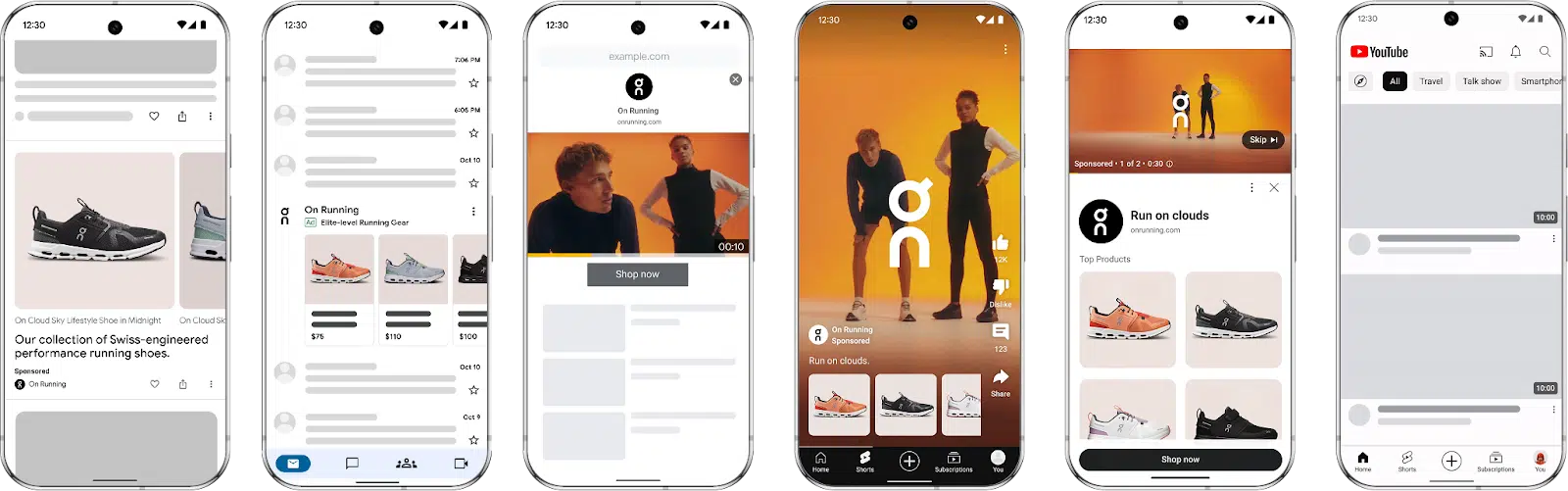
3. Demand Gen: consolidation of the new advertising model
28 February 2026 marks the final transition to Demand Gen as the main advertising format across Google’s visual environments.
Video Action campaigns are no longer available, consolidating a model specifically designed for platforms such as Shorts, Discover and Gmail.
Key features:
- Native integration in visual environments
Demand Gen is optimised for discovery contexts, where creativity plays a decisive role. - Advanced use of similar audiences
It makes it possible to scale reach using first-party data, improving efficiency when acquiring new users. - Reliance on first-party data
The quality of first-party data becomes a key factor in campaign performance.
Early implementations are showing relevant efficiency gains, with average ROAS increases that demonstrate better alignment between creativity, audience and context.
4. Measurement and attribution: towards a more connected ecosystem
Measurement is evolving towards a more integrated model, where the connection between platforms and signals reduces operational complexity and improves analytical capabilities.
Relevant updates:
- Automatic linking between YouTube and Google Ads (April 2026)
Google automates the connection between highly trusted accounts, facilitating data collection and reducing setup errors. - New optimisation goals
Bidding strategies can now optimise not only for traditional conversions, but also for metrics such as subscriber growth. - Evolution of the CTV environment towards shoppable experiences
Connected TV now includes features that allow users to interact with products directly from the device, integrating mechanisms such as QR codes or mobile synchronisation.
This approach reinforces brands’ ability to understand the full user journey and optimise their strategies based on more accurate and connected data.
Video as a growth infrastructure
The main shift in 2026 is not the evolution of the format itself, but the transformation of the role video plays within digital strategy.
It stops being an isolated content asset and becomes a growth infrastructure, where creativity, catalogue and measurement operate in an integrated and coordinated way.
In this context, producing strong assets or launching efficient campaigns independently is no longer enough. The brands achieving the best results are those capable of building systems where:
- Creativity is generated, tested and optimised continuously.
- The catalogue is structured to support dynamic activation and direct sales.
- Measurement connects every touchpoint and enables real-time decision-making.
This shift also implies a new way of operating. The hybrid 70/30 model is becoming a working standard:
- 70% based on automation and artificial intelligence, enabling production at scale, greater efficiency and faster learning.
- 30% focused on the strategic and creative layer, where positioning, narrative and brand differentiation are built.
When this balance is implemented correctly, the result is not only improved short-term performance, but the creation of a sustainable system that drives growth consistently.
In this scenario, the question is not whether brands should adapt, but whether their ecosystem (from catalogue management to measurement) is ready to operate in an integrated way.
Because in 2026, video does more than generate impact: it structures, optimises and converts.