If hearing Microsoft Advertising still makes you think automatically of “advertising on Bing,” it's time to update your perspective.
While conversations in digital marketing increasingly revolve around artificial intelligence, new search engines, fragmented customer journeys and users who need fewer clicks to make decisions, Microsoft has been building an advertising ecosystem that goes far beyond a search results page.
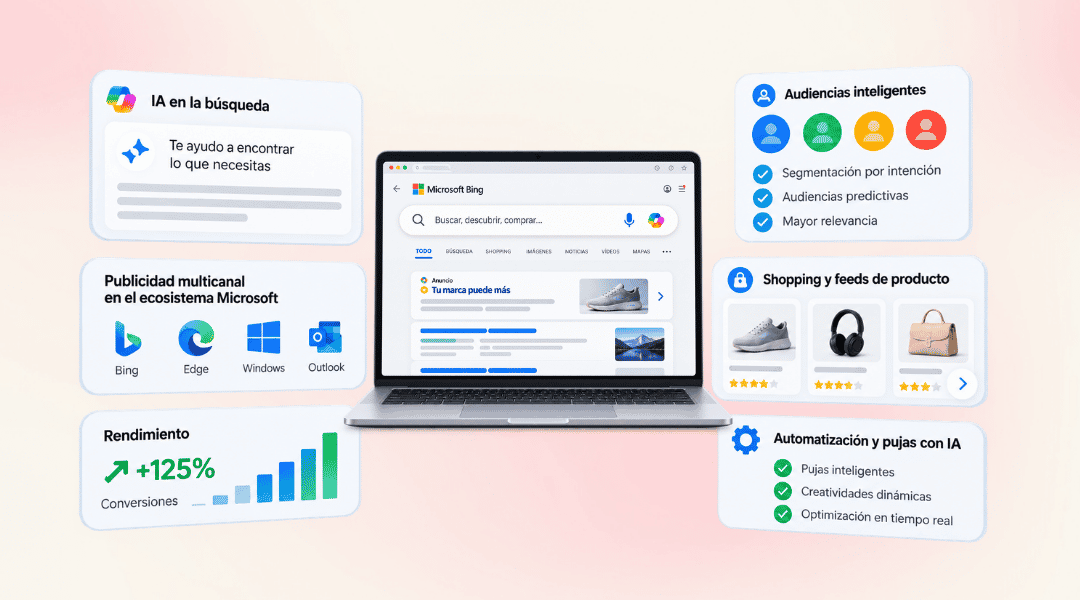
Bing is still part of the picture, of course. But we're now also talking about Copilot, Edge, MSN, Outlook, Audience Ads, Performance Max, intelligence powered by LinkedIn data and new AI solutions for Search.
So the question should no longer be: “Is investing in Bing Ads worth it?”
There's a much more interesting question: What role can Microsoft Advertising play in a multichannel growth strategy?
What is Microsoft Advertising?
Microsoft Advertising is Microsoft's advertising platform, formerly known as Bing Ads. It enables brands to run search, shopping, display, native and other advertising formats across Microsoft's ecosystem.
And here's the important part: that ecosystem doesn't begin and end with Bing.
Campaigns can reach different touchpoints, including Bing, Microsoft Edge, MSN, Outlook and Copilot-powered experiences, alongside other placements across the Microsoft Advertising Network. Performance Max, for example, combines this inventory to optimise conversion acquisition.
That's why thinking of Microsoft Advertising as simply a secondary search engine misses the bigger picture.
Search is changing. And Microsoft wants to lead the way
The way we search for information is no longer the same.
We're moving from short keyword-based queries to much longer, more conversational questions. We compare products with AI assistants. We ask for recommendations. We refine our decisions without having to jump between ten different web pages.
In other words, search is becoming more and more like a conversation.
And Microsoft is particularly well positioned for this transition thanks to Copilot's integration across its ecosystem.
Microsoft is already developing advertising experiences designed specifically for these new environments. One example is Offer Highlights, which can display specific product attributes, such as free delivery or in-store pickup, in the context of conversations and product pages across Copilot, Edge and Bing.
This isn't simply about placing an ad next to an AI-generated answer.
It's about thinking how a brand can become visible during the process in which AI helps users compare, evaluate and decide.
And that changes the rules of the game.
AI Max: bringing AI directly into Search campaigns
One of Microsoft Advertising's most significant developments in 2026 has been the launch of AI Max for Search campaigns.
AI Max adds artificial intelligence capabilities to traditional campaigns through three main levers:
- Intelligent expansion of query matching;
- Automatic personalisation of ad copy;
- Selection and expansion of final URLs to direct users to the most relevant landing page.
Microsoft has also introduced brand controls, keyword exclusions and dedicated reporting to make this automation more transparent.
The thinking behind AI Max is a pretty good reflection of where paid search is heading.
It's no longer enough to try to anticipate every possible keyword someone might use.
As people begin searching with more complex phrases, particularly in conversational interfaces, platforms need to interpret intent, not just keyword matches.
That doesn't mean forgetting strategy and handing the keys over to the machine. Quite the opposite.
The more automation we bring into campaigns, the more important it becomes to define what we want to achieve, which signals we feed the algorithm, what content it can use, where ads may appear and how we measure results.
AI handles more of the execution. But someone still has to decide what good execution looks like.
Performance Max is also gaining ground in Microsoft's ecosystem
Performance Max is another key part of this evolution.
Microsoft's PMax campaigns use AI to distribute and optimise assets across different formats and inventory, combining Search, Audience, Native and Display in a single campaign.
Throughout 2026, Microsoft has focused particularly on strengthening two areas that have historically generated plenty of debate around this type of campaign: control and transparency.
Recent improvements include reporting on search terms, landing pages and publishers, along with additional share-of-voice and performance insights.
Specific objectives for new customer acquisition have also been introduced, allowing advertisers either to bid more for new customers or to focus campaigns exclusively on acquiring them.
What's the strategic takeaway? Performance Max makes sense when automation receives the right signals.
A PMax campaign fuelled by conversions that don't reflect business value, mediocre assets or a messy product feed will still have a problem, no matter how much AI you add.
One particularly interesting advantage: LinkedIn's professional audiences
There's another Microsoft Advertising differentiator that surprisingly often flies under the radar: its integration with professional data from LinkedIn.
Microsoft allows advertisers to use professional profile attributes to target campaigns based on work-related variables. In 2026, it also introduced Job Seniority, covering levels such as CXO, VP, Director, Manager and Owner for both Audience Ads and Search campaigns.
This opens up particularly interesting possibilities for B2B strategies.
Think, for example, of a SaaS company selling financial software to large enterprises. A traditional strategy might focus on competing for searches such as “enterprise financial planning software”.
With Microsoft Advertising, we can add another layer: connecting that search intent with the audience's professional characteristics.
It doesn't replace a solid keyword strategy or automatically turn every impression into a qualified lead.
But it does move us closer to an increasingly valuable combination: intent + professional context.
Audience Ads: Microsoft doesn't want to rely on Search alone
Microsoft is also strengthening its Audience Ads, especially through contextual targeting.
Brands can now use placement targeting across properties such as MSN, Outlook, Microsoft Casual Games and Edge, while selecting content topics relevant to their audiences. Microsoft has also introduced dedicated reporting to show where ads are served.
This makes it possible to use Microsoft Advertising for more than capturing existing demand.
We can work across different funnel stages: Discovery → consideration → search → conversion → remarketing.
And that's where one of the most interesting opportunities lies: stopping thinking of each platform as its own little universe.
So, does Microsoft Advertising compete with Google Ads?
Yes. But framing the strategy solely as a Google Ads vs. Microsoft Advertising battle is probably missing the point.
For many brands, Microsoft doesn't need to replace Google; it can complement it. The real question is where it delivers incrementality.
It can bring in new users, different professional audiences, additional inventory or search and discovery contexts that don't necessarily behave the same way as on other platforms.
It also allows campaigns to be imported from the Google ecosystem, reducing some of the operational friction involved in testing the channel. So the strategy shouldn't start with the question: “What percentage of our budget should we take away from Google?”
It should start with: “What demand are we currently missing?”
Which brands could benefit most from Microsoft Advertising?
There isn't a one-size-fits-all answer, but several scenarios make it particularly worth testing.
1. B2B brands
Its ability to combine Search with professional signals from LinkedIn can make it especially relevant for companies looking to reach specific decision-making roles.
2. Ecommerce and retail
Shopping, product feeds, Performance Max and new commerce experiences around Copilot create new possibilities both for capturing intent and supporting the consideration process.
3. Brands with mature paid search strategies
When Google Ads already accounts for a significant share of acquisition, exploring Microsoft can add another source of demand and reduce reliance on a single ecosystem.
4. Companies interested in testing AI Search
Copilot makes Microsoft Advertising one of the environments where brands can begin to understand how advertising is changing as search, recommendations and conversation increasingly overlap.
How to get started with Microsoft Advertising the right way
Opening an account and copying over existing Google campaigns can be a useful starting point. But stopping there would mean leaving a lot of potential untapped. A stronger strategy should address at least five areas.
1. Measurement
Before scaling investment, make sure conversions reflect real business outcomes.
A lead isn't necessarily a qualified lead. A purchase doesn't always mean profit. And ROAS doesn't always equal growth.
2. Audiences
Microsoft provides its own audience signals, which are worth exploring rather than simply replicating the targeting used on other platforms.
3. Creative
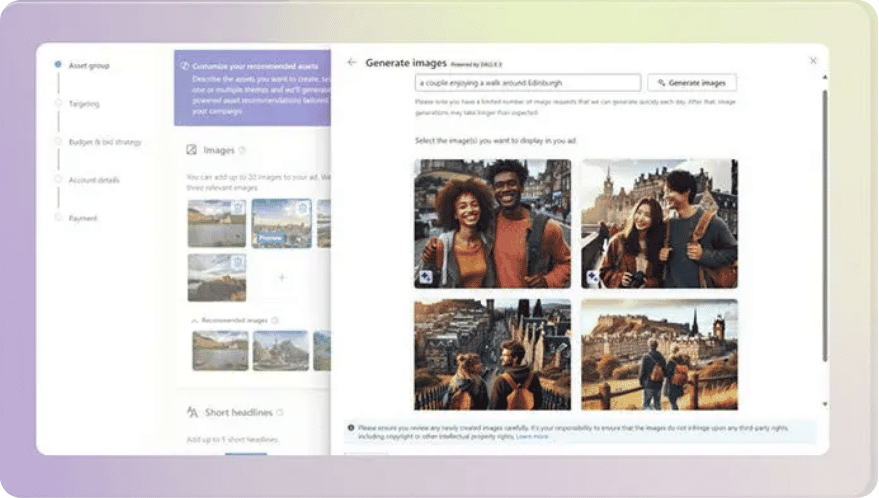
Search also needs creative variety. Microsoft is introducing asset generation and recommendations through Copilot, as well as automatically generated assets for Responsive Search Ads.
4. Automation
AI Max and Performance Max can extend reach and capabilities, but they need properly managed goals, exclusions, signals and product feeds.
5. Incrementality
Channel success shouldn't be measured only by comparing CPCs with Google.
What matters is how many additional users, conversions or revenue the channel brings into the system.
The real change isn't Microsoft Advertising. It's how we think about Search
The evolution of Microsoft Advertising is another sign of something much bigger.
Search is moving beyond a box where we type words and get ten links back. We now search, ask, converse, compare and receive recommendations through increasingly AI-assisted experiences.
That means brands need to broaden the way they think about paid media. Competitive advantage will no longer come only from knowing how to configure a campaign better than everyone else.
It will come from connecting data, audiences, creative, automation, technology and measurement so that every platform has enough context to make better decisions.
Microsoft Advertising can become a relevant part of that architecture. Not because Bing has replaced Google. And not because brands should chase every new platform that appears. But because the decision-making journey is changing. And when the places where people discover, compare and decide change, the places where brands build demand need to change too. At Adsmurai, we see paid media as part of a connected growth system: we combine strategy, technology, data and artificial intelligence to identify genuine growth opportunities, activate the right channels and measure their impact on business outcomes. Because adding another platform to your media plan is easy.
Making sure it delivers incremental growth is another story.