Over the past few years, talking about artificial intelligence in marketing meant talking about experimentation.
Generating an image. Testing a new model. Automating copy. Creating a video from a prompt. Summarising information. Speeding up a task that previously took hours.
AI entered marketing departments through small use cases and, in a very short time, demonstrated its ability to transform processes that had been operating in virtually the same way for years.
But the market is entering a new phase.
The question is no longer what artificial intelligence can do, but how to integrate it into teams’ day-to-day work to produce better, operate faster and scale without multiplying tools, processes and complexity.
And that shift is beginning to transform the very structure of marketing.
AI is already part of the marketing landscape
Artificial intelligence has moved beyond being an experimental technology to become a new layer of the marketing ecosystem.
Advertising platforms, creative tools, CRMs, analytics solutions, search engines, social platforms and enterprise suites are incorporating AI models into virtually every stage of the customer journey.
We are not just talking about generative AI. We are talking about systems capable of analysing large volumes of information, identifying patterns, predicting behaviour, automating decisions, generating content and adapting experiences to different audiences.
The result is a market where an increasing number of decisions and processes can be assisted by artificial intelligence.
But incorporating AI does not necessarily mean transforming the way teams work. And that is where one of the biggest challenges of this new stage emerges.
From a lack of tools to too many tools
A few years ago, the problem was finding a solution capable of performing certain tasks. Now, almost the opposite is true.
A team might use one tool to generate images, another for video, another for audio, different language models to work with text and prompts, additional platforms for editing, and other systems to manage the resulting assets.
Each tool may solve one part of the process very well. The problem appears when we look at the system as a whole.
More tools also mean more logins, costs, processes, providers, learning curves and difficulty maintaining a consistent way of working.
The paradox is quite clear: AI promises to simplify marketing, but fragmented adoption can end up making it more complex.
That is why the next stage of artificial intelligence is not simply about adding more models to the technology stack. It is about orchestrating them.
The real shift: from using AI to operating with AI
The first stage of adoption revolved around the prompt.
A person asked a model for something and received an output. The next stage goes much further.
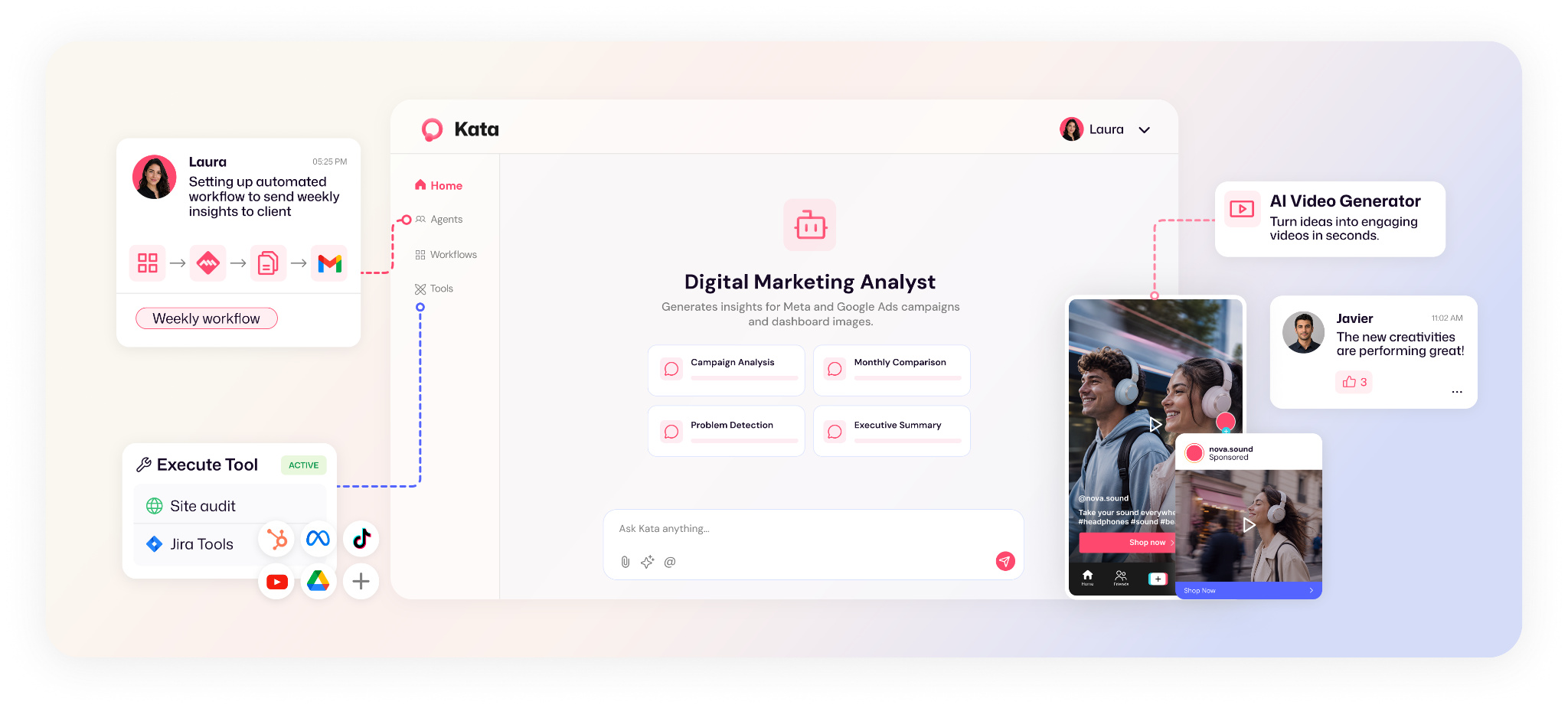
AI is beginning to integrate into complete workflows: receiving information, interpreting context, generating different outputs, enabling teams to iterate on them and connecting specialised models within the same process.
This changes the conversation. For marketing teams, the value is no longer simply being able to generate an asset in seconds. It lies in reducing the distance between an idea and its execution.
For example, a campaign may require product images, different creative adaptations, videos for social media, versions for paid media, audio assets and multiple iterations for different markets or audiences.
Traditionally, each of these needs involved different tools, processes and timelines.
With a connected AI architecture, much of that journey can begin to be managed from a single environment.
And that has direct implications for three fundamental marketing variables: speed, scale and efficiency.
Content production is one of the first major areas of transformation
Few areas illustrate this shift as clearly as creative production. Brands need more and more content.
More platforms mean more formats. More segmentation means more versions. More markets require more adaptations. And the need to maintain an active presence throughout the customer journey further multiplies demand.
The problem is that resources are not growing at the same pace.
Generative AI introduces a new production capacity that enables teams to expand their possibilities without proportionally increasing traditional costs and production times.
A single idea can become different images, videos or audio assets and evolve quickly through multiple iterations.
But producing more should not become the goal.
The real potential lies in building better production systems.
Systems where teams can choose the most suitable model for each need, maintain control over the creative process and work with AI in an environment specifically designed for marketing.
That is where KATA Media Studio comes in
At Adsmurai, we have been working with artificial intelligence applied to different areas of marketing for some time. That experience has led us to a fairly simple conclusion: teams do not need another standalone AI tool.
They need a more efficient way to work with them.
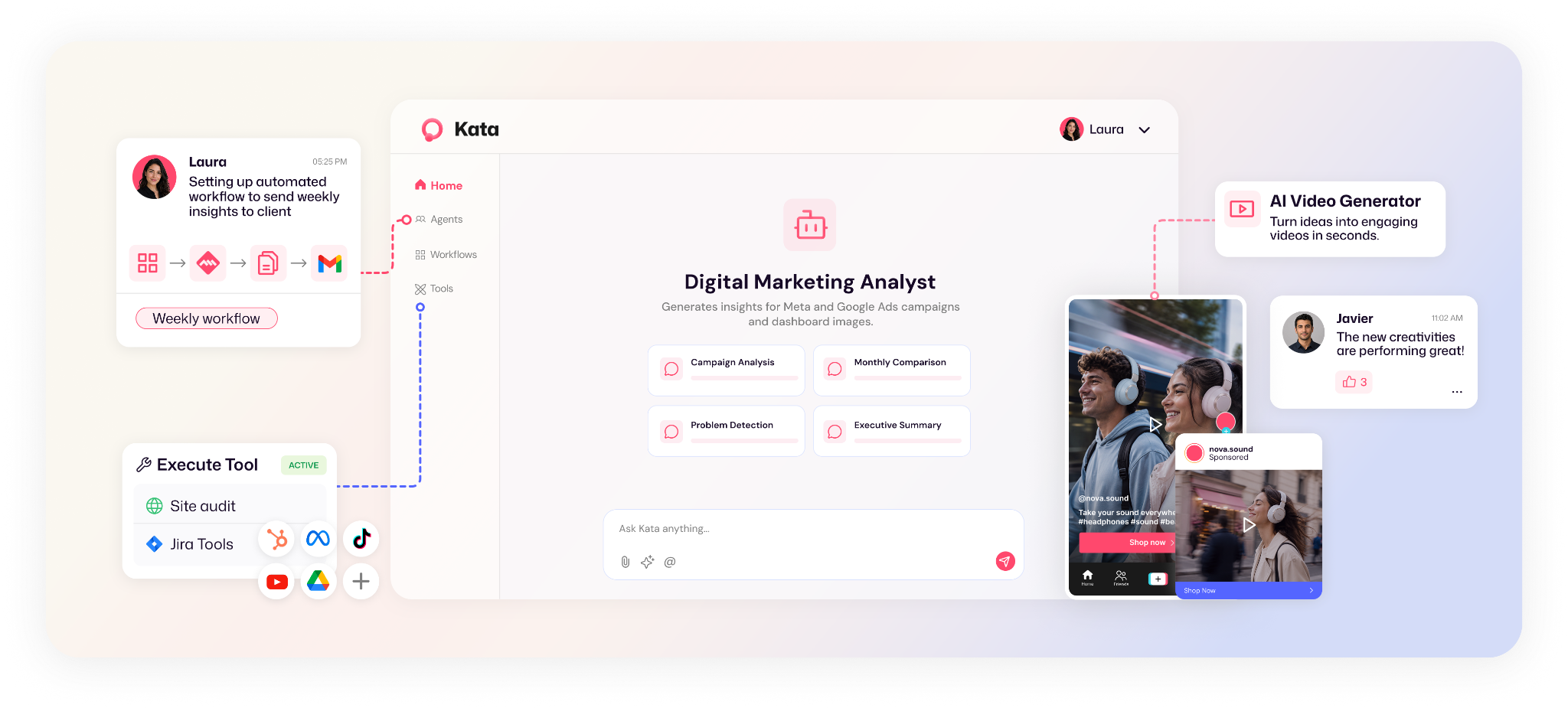
That is why we developed KATA Media Studio, an AI-powered content creation environment that centralises different image, video and audio generation capabilities within a single platform.
Instead of constantly switching between tools, KATA provides access to different AI models from one place, allowing teams to select the most suitable technology for each creative need.
The process starts with something as simple as a prompt or a reference image.
From there, teams can generate new assets, test different models, configure formats and quality, iterate on results and adapt content for different uses and campaigns.
For images, for example, teams can create new visuals from text instructions or existing references.
For video, they can generate clips using prompts or transform static images into audiovisual content.
Audio capabilities further expand production possibilities within the same environment.
All built around one common principle: less friction between the idea and the final asset.
A Media Studio designed for marketing teams
The key difference is not simply bringing different AI models together.
It is about building an experience around real marketing needs.
Because teams do not generate content simply to see what a model is capable of.
They generate it to launch a campaign, showcase a product, feed a catalogue, create new creative variations, adapt an asset to different platforms or respond more quickly to an opportunity.
KATA Media Studio is designed precisely around this logic.
It enables teams to incorporate AI into their creative workflows without turning the selection and management of technologies into yet another task.
So the conversation shifts from: “Which tool should we use to do this?”
to: “What do we want to create?”
It may seem like a small change. In practice, it significantly changes the way teams work.
The product catalogue also becomes part of the equation
For brands working with large catalogues, the opportunity is even greater.
A catalogue contains hundreds or thousands of products that constantly need to be transformed into visual experiences capable of competing for consumers’ attention.
AI makes it possible to work with that creative inventory in a much more dynamic way.
A product can be placed in different contexts, adapted to new visual compositions or used as the starting point for generating new assets without having to rebuild the entire production process from scratch.
When these capabilities are connected to product information, the catalogue stops being merely a source of data and also becomes a creative production engine.
And that opens up a new way of understanding the relationship between catalogues, creativity and advertising activation.
The advantage will not come from having access to AI
Virtually any marketing team can access artificial intelligence models today.
That is why access to the technology itself is unlikely to be a sustainable competitive advantage.
The difference will lie elsewhere. In how it is integrated. In which processes it transforms. In what information it uses. In how it connects with the rest of the ecosystem.
And, above all, in the ability to combine the speed of technology with the judgement of the people making the decisions.
AI can generate hundreds of possibilities. But someone still needs to decide which ones make sense for the brand, the audience and the business objective.
That is where technology and expertise stop competing and start multiplying each other’s impact.
The next phase of marketing will be less fragmented
For years, we have built technology stacks by adding specialised tools to solve specific needs.
Artificial intelligence now offers a different opportunity: to start connecting many of those capabilities within smarter, more accessible systems.
KATA Media Studio represents this vision applied to content creation.
A single environment where teams can use different AI models, generate multiple types of assets and accelerate their creative workflows.
Because the next stage of AI is not about discovering another impressive tool every week.
It is about getting all that technology to work together.
And allowing us to focus on what still matters most: deciding what is worth creating.
.png)