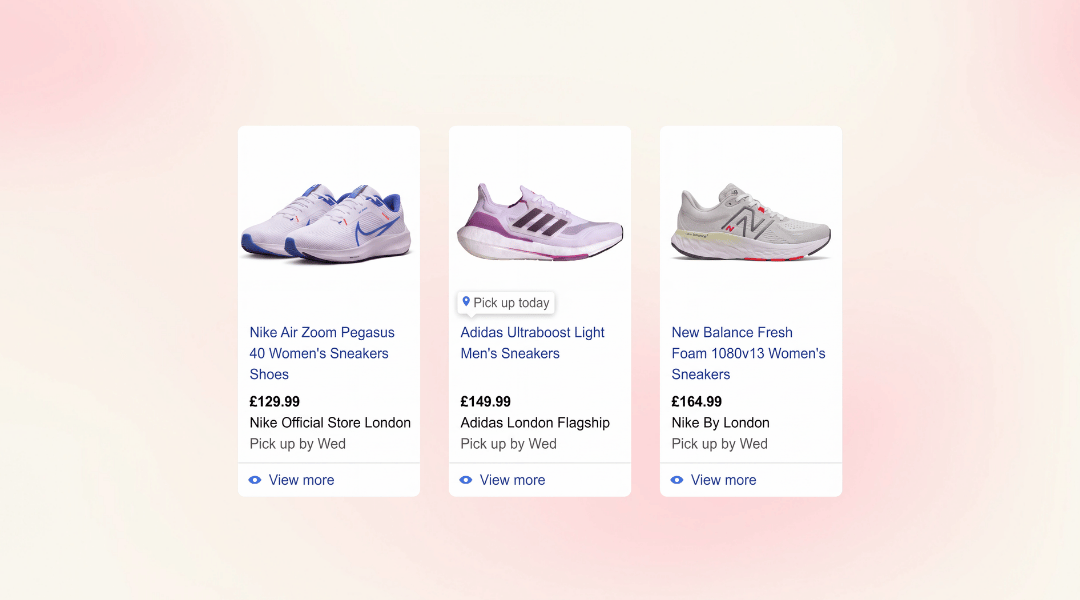
For years, the logic of local retail was fairly straightforward: if a product was available in a store, you could buy it or pick it up there. If it was out of stock, that store practically disappeared from the purchase decision.
Google Pickup Later introduces a small difference that can have a significant impact for many brands: the store no longer needs to physically have the product in stock to be part of the sale.
The idea is simple. A user finds a product on Google, buys or reserves it online, and chooses to pick it up at a nearby store. The product is not there yet, but the brand can ship it from its warehouse, ecommerce operation, or another distribution point and have it ready a few days later.
In other words, the store goes from selling only what it has available at that moment to also serving as a pickup point for a much larger share of the online catalogue.
And that significantly changes the conversation around local inventory.
What is Google Pickup Later?
It is a Google feature linked to Shopping ads that allows users to see that a product can be purchased online and picked up later at a physical store, even if that item is not available there at the time of the search.
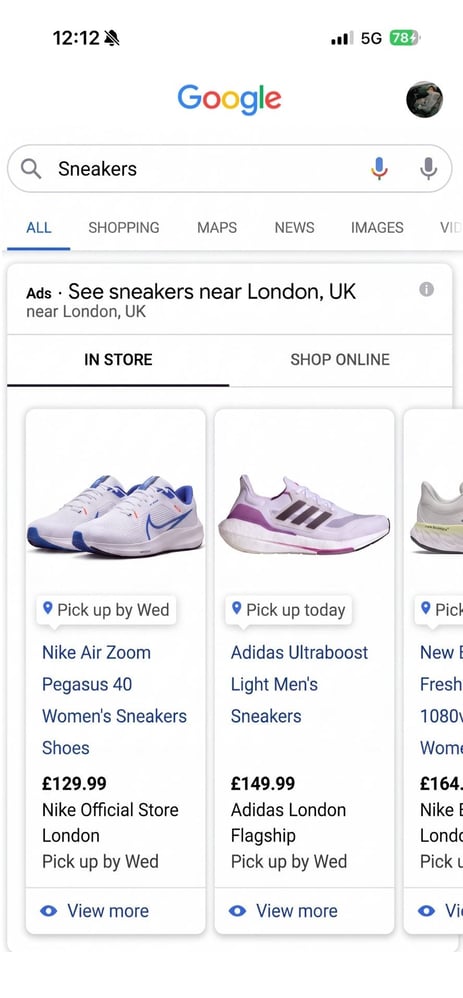
The difference compared with other pickup options is precisely the timing.
- With Pickup Today, the product is already available locally and can be collected the same day or within a very short timeframe. With Pickup Later, the product is available to buy online but needs to be shipped to the store before the customer can collect it. Think, for example, of a fashion brand. A user finds a pair of trainers on Google and has one of the brand’s stores close to home, but their size is not available there. Until now, they would probably have ended up buying them online for home delivery or looking for another store.
- With Pickup Later, a third option becomes possible: buying them online and collecting them from that store three days later. For the customer, it is simply another option. For the brand, it means connecting the online catalogue with its physical store network without having to stock every product, size, and variant in every location.
The store is no longer limited by the stock it holds
A physical store has an obvious limitation: space. An ecommerce store, on the other hand, can offer a much broader catalogue. Add sizes, colours, models, slow-moving products, or seasonal items, and keeping the entire catalogue available in every location quickly becomes unrealistic.
Pickup Later helps separate two concepts that have traditionally been closely linked: having a product in a store and being able to sell it through that store.
A store may not currently have a specific product in stock and can still participate in the sale because the brand has the ability to ship the product there. This is especially relevant for retailers with large and complex catalogues (fashion, sports, beauty, electronics, home). The store stops functioning solely as an inventory space and also becomes a logistical extension of ecommerce.
What changes strategically for a brand?
Implementing this solution is not just a logistical change; it is a growth and profitability lever backed by data:
- Higher-value customers: Omnichannel shoppers are the most valuable segment; they spend 3 times more than customers who shop exclusively in physical stores, and up to 7 times more than those who shop only online.
- Improved cross-channel performance: Retailers using Local Inventory Ads see, on average, a 21% increase in store visits and a 9% increase in online conversions.
- Greater coverage without overcrowding the store: You can turn your physical store network into an extension of your ecommerce operation, offering your full online catalogue without needing to physically stock every size or variant in each location.
- Channel alignment: Stores stop competing with ecommerce for sales attribution. The online channel provides the catalogue, while the store provides proximity, also creating opportunities for cross-selling when customers come to collect their order (85% of consumers make additional purchases when they arrive at the store).
Requirements for implementation
For Google to approve and activate this feature, certain attributes need to be configured in your catalogue and Google Merchant Center, while the user experience (UX) on your website must clearly display pickup options and timeframes before payment.
You can consult the full list of technical and configuration requirements on the official Google support page.
How does Adsmurai help implement Google Pickup Later?
Activating this feature requires aligning technology, catalogues, and advertising strategy. As a Google Premier Partner, Adsmurai acts as the operational bridge to launch this format quickly and without technical friction:
- Smart feed management: We automate and inject key attributes directly into your main catalogue through our platform, without requiring changes to your ecommerce’s native development.
- UX audit and compliance: We support your team in ensuring that the checkout flow and website experience fully comply with Google’s requirements before launch, helping ensure approval.
- Omnichannel activation and measurement: We design the architecture of your campaigns (Shopping, Performance Max) and measure the real impact by connecting digital investment with sales generated in your physical stores.