
For years, growth in digital marketing seemed like a fairly straightforward matter: more investment, more campaigns, more audiences, more formats, more impressions. An apparently flawless formula. Until it stopped being one.
Because today’s ecosystem has changed. Users no longer move through linear journeys. They do not discover a brand on one channel, consider it on another and calmly purchase on a third while the marketing team measures everything with perfect attribution. If only. The reality is a little more uncomfortable: they jump between platforms, consume content at different moments, switch screens, mute videos, compare options, receive constant stimuli and make decisions in increasingly fragmented contexts.
In this scenario, the big question is no longer just how to reach more people. It is how to reach them better.
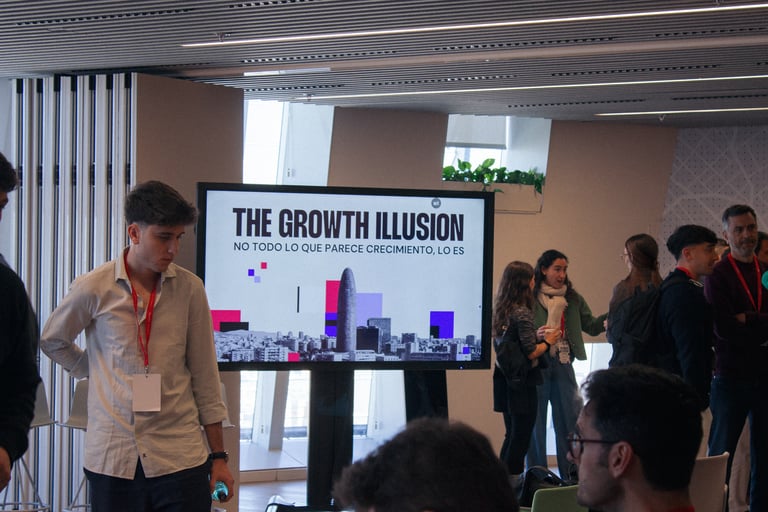
That was one of the key learnings from Tech Morning: The Growth Illusion, an event organised by Adsmurai that brought together different companies and leading voices from the digital ecosystem to share ideas, cases and perspectives on the new rules of growth, measurement, attention and the real value of media in an increasingly competitive environment.
Among the different ideas shared throughout the morning, the block “Battle of Attention: Where Premium Media Wins” focused on one of today’s biggest marketing battles: attention. Based on contributions from companies such as Spotify, Uber, Criteo, Xplain and Netflix, this block left several reflections on how brands can generate impact in a context where users are exposed to more stimuli than ever, but pay attention to far fewer of them.
And that is where a key idea emerged: real growth is not built solely on volume, but on context, attention, creativity, measurement and connected technology.
Because yes, reaching lots of people looks lovely in a report. But if nobody pays attention, if the channel does not fulfil a clear role or if each platform measures success separately, perhaps we are not growing as much as we think. Perhaps we are just making more noise.
Attention as the new frontier of growth
The block “Battle of Attention: Where Premium Media Wins” started from an obvious tension: in digital, reaching people has never been easier, but capturing attention has never been more complex.
The problem is no longer just the saturation of impressions. It is the quality of those impressions. An impression can be served correctly, a video can load, a campaign can achieve reach and frequency… but none of that guarantees that the user has paid real attention.
For years, much of the industry has measured growth through exposure metrics: impressions, reach, frequency, clicks, views. All of them are necessary, of course. But none of them answers a much more uncomfortable question on its own: has that impact generated anything in the user’s mind?
This is where premium environments, contextual creativity and attention measurement start to gain weight. Because not all impressions are worth the same. Not all seconds of exposure have the same quality. And not all channels fulfil the same role within the journey.
1. From targeting to moments: relevance starts with context
One of the most powerful learnings came from Spotify: mobile has become one of the best connection points with users because it allows brands to reach them at the right moment. But the key is not just the device. It is the context.
Spotify presented an interesting view: personalisation does not depend solely on hyper-specific targeting, but on signals and creatives capable of adapting to the moment. In other words, it is not just about defining who the user is, but understanding what they are doing, how they consume content and what type of message might make sense at that instant.
This significantly changes the traditional planning logic. For a long time, the main question has been: “which audience do we want to impact?”. Now it is becoming just as important to ask: “at what moment does it make sense to appear?”.
Because not all impacts have the same value. A message can be irrelevant in one context and perfectly timely in another. The same creative can work or go unnoticed depending on the moment of consumption, the format and the user’s attention state.
In the case of audio, this logic is especially clear. Spotify argued that it does not compete with video, but complements it. And there is an important strategic reading here: in a world saturated with visual stimuli, audio makes it possible to connect with moments where the screen is not always the main focus.
There is also a very revealing concept: the mute test. What happens when a user mutes a video? The brand may still be visually present, yes, but part of the message disappears. Audio, on the other hand, opens another path to generate recall, attention and incrementality.
The lesson for brands is direct: it is not enough to design campaigns for audiences; they must be designed for moments.
2. Moments of action: when advertising gets closer to real decision-making
Uber took this idea one step further by talking about moments of action and real-time interaction. Its approach does not focus only on reaching users, but on connecting with them while they are doing things: travelling, waiting, making decisions, interacting with their surroundings or solving an immediate need.
This point is key because it introduces an important difference between passive consumption and active consumption. It is not the same to impact someone while they are browsing without a clear intention as it is to appear at a moment where an action is already taking place.
In these contexts, advertising can become more relevant because it is integrated into a specific situation. The brand does not appear as an isolated interruption, but as part of a decision-making moment.
Personalisation, then, stops being just a matter of user data and becomes a matter of opportunity. The value lies in understanding the immediate context: what is happening, what the person needs and how a brand can provide something useful at that instant.
Here, the question for marketing teams changes radically. It is no longer only: who do we want to reach?
But also: what is happening when we reach them?
And that second question often separates campaigns that simply appear from campaigns that truly influence.
3. Contextual creativity: fewer generic assets, more useful signals
Another idea that ran through several talks was the need to evolve creativity. It no longer makes sense to think of a single asset for every context, every format and every moment of the journey.
Spotify pointed to the possibility of generating creatives adapted to different models, signals or contexts. This connects with an increasingly clear trend: creativity stops being a static asset and starts working as a dynamic system.
The question is no longer just “what message do we want to launch?”, but “what combination of message, format, channel and moment can generate the greatest impact?”.
Technology plays an important role here. Automation and AI make it possible to produce more variants, adapt messages and test combinations at a speed that was previously unthinkable. But the important point, and here comes the part that is sometimes forgotten when someone discovers a new tool and thinks they have reinvented marketing, is that producing more creatives does not guarantee better results.
What makes the difference is producing better combinations.
More versions do not mean more relevance if they are not connected to clear signals. Contextual creativity needs data, yes, but also strategic judgement. It needs to understand which variable is being adapted and why: the moment, the product, the need, the channel, the funnel stage, the audience or the environment.
Creativity can no longer live separately from planning and measurement. It has to become part of the growth system.
4. Attention: the metric that forces us to look beyond the impression
Xplain brought one of the most relevant conversations for the future of measurement to the table: attention as a metric of efficiency.
For a long time, the industry has measured whether an ad was served, whether it was viewable or whether it received a click. But that does not always answer the most important question: did the user actually notice the ad?
Attention introduces a layer of quality. It helps understand how long a person paid attention, under what conditions and which variables influenced that behaviour. As Xplain shared during the morning, attention measurement can be based on between 15 and 20 variables, because attention does not depend on a single factor.
Format, environment, moment, creative clarity, position, type of content, duration and the combination of all these elements all play a role. And the most interesting part is that these combinations change. What works in one environment may not work in another. What captures attention at one moment may lose strength at another.
There is a very important lesson here: not all impressions are worth the same.
An impression in a premium environment, with clear creativity and at the right moment, can have much more value than several impressions served in low-attention contexts. Measuring this difference makes it possible to optimise not only towards cost efficiency, but towards real impact efficiency.
Because optimising only for a low CPM can be very tempting. So is buying cheap shoes that destroy your feet. Not everything that is price-efficient is results-efficient.

5. Reach, frequency and brand value: the Netflix project
Netflix structures its approach around three major blocks: reach and frequency, attention and branding value.
This vision sums up very well where media planning is heading. Reach is still important, of course. So is frequency. But they can no longer be analysed in isolation. The relevant question is what happens after the impact: whether there was attention, whether recall was generated and whether there is a real effect on the brand.
Among the ideas shared during the morning, one especially relevant figure stood out: a 20-second video can achieve a 70% view rate.
It is not the same to appear in a context where the user is willing to watch content as it is to appear in one where advertising is perceived as yet another interruption within the noise. Brand value is built in that difference.
For years, many strategies have separated performance and branding too much, as if they were opposing worlds. But sustainable growth needs both. It needs activation and memory. Conversion and preference. Immediate impact and long-term building.
The problem is that the immediate is usually easier to measure. And when something is easier to measure, the industry tends to overvalue it. What a surprise: the dashboard bossing the strategy around.
6. Performance beyond the transaction: Criteo’s cross-channel challenge
Criteo addressed one of the biggest pain points in digital marketing today: the purchase process has become more complex and technology is not always ready to manage it properly.
Users browse across different channels, compare products, switch devices, interact with different formats and make decisions through increasingly unpredictable journeys. In this context, understanding performance solely as the final conversion falls rather short.
Performance no longer lives only in the transactional part. It also lies in the ability to generate consideration, recover intent, connect signals and activate relevant messages at different points of the funnel.
Criteo’s proposal points towards a cross-channel and full-funnel approach, where the same campaign can operate across different channels and where attribution makes it possible to better understand the role each one plays. This is key to solving one of the most common problems in today’s ecosystem: fragmentation.
When each channel operates separately, each platform optimises towards its own result. Each team looks at its own metrics. Each report tells one part of the story. And in the end, the brand has many tactical answers, but little strategic vision.
Unified measurement helps avoid this disconnection. It makes it possible to understand where each channel is adding value, how they interact with one another and which investment decisions make the most sense.
From doing more to making better decisions
If the ideas shared during Tech Morning: The Growth Illusion made one thing clear, it is that digital growth needs a new mindset. For a long time, the focus was on scaling activation. More campaigns, more audiences, more formats, more automation. But the next leap is not about doing more. It is about making better decisions.
Technology is essential to achieve this, but not as an isolated layer. AI, automation, advanced measurement and cross-channel platforms only generate impact when they are part of a connected architecture.
Because a tool can optimise a campaign. But a well-built system can transform how a brand learns, decides and grows.
That is the difference between the illusion of growth and real growth.
At Adsmurai, we help brands transform their marketing into a connected, measurable and scalable growth system. We combine proprietary technology, data, AI and strategic expertise to connect decisions, investment, creativity and business results.
What brands can do from now on
Are we planning around audiences or moments?
Audiences are still important, but context can completely change the relevance of the message. A mature strategy should combine both dimensions.
Does our creativity respond to real signals?
It is not about multiplying assets without purpose, but about adapting messages to moments, formats, products, needs and funnel stages.
Are we measuring attention or just exposure?
An impression does not guarantee impact. Incorporating attention metrics helps understand the real quality of the advertising contact.
Do we have a full-funnel vision or disconnected campaigns?
The user does not live within the limits of a single platform. The strategy should not either.
Are we optimising towards tactical metrics or towards business growth?
Performance should not be measured only by clicks or immediate conversions. It should also be measured by recall, consideration, incrementality and brand value.