The digital landscape has been evolving for years toward a more privacy-first model. Stricter browser policies, widespread use of ad blockers, Safari’s ITP, the limitations progressively introduced by Chrome and, above all, the declining value of third-party cookies are reducing the amount of signal that reaches advertising platforms.
The outcome is clear: fewer recorded events, incomplete attribution, and underfed algorithms. When the algorithm has less signal, campaigns stop performing at their full potential.
In response, different ecosystems have introduced solutions based on first-party data: Meta’s Conversions API (CAPI), TikTok’s Events API, server-side tagging, enhanced conversions… Google Tag Gateway is the latest addition, specifically designed for the Google ecosystem, and it fits within this same family of solutions.
TABLE OF CONTENTS
-
Google Tag Gateway + Enhanced Conversions: the combination that makes sense
- Google Tag Gateway and Adsmurai One Tag: how they fit together
-
What is Tag Gateway and why should you activate it?
Google Tag Gateway allows the Google tag (Google tag / gtag.js) to be loaded from your own domain instead of a Google domain. In other words, when a user visits your website, the tag request and measurement calls are served from your infrastructure, not from a third-party domain.
To make this possible, Google integrates with your CDN (Cloudflare, Akamai, Fastly, among others) and routes these requests through your domain. This does not mean moving Google’s libraries to your server or hosting them yourself: the logic still lives within Google. What changes is the delivery channel, which becomes first-party.
This has two key effects on measurement:
- Ad blockers and browser restrictions that filter third-party domain requests no longer affect these calls.
- Associated cookies become first-party, with greater persistence.
In projects where we’ve implemented it, we are seeing an uplift of 10% to 20% in recorded signals after deployment. The logic is simple: more signals mean better attribution, and better signals feeding the algorithm result in stronger campaign performance.
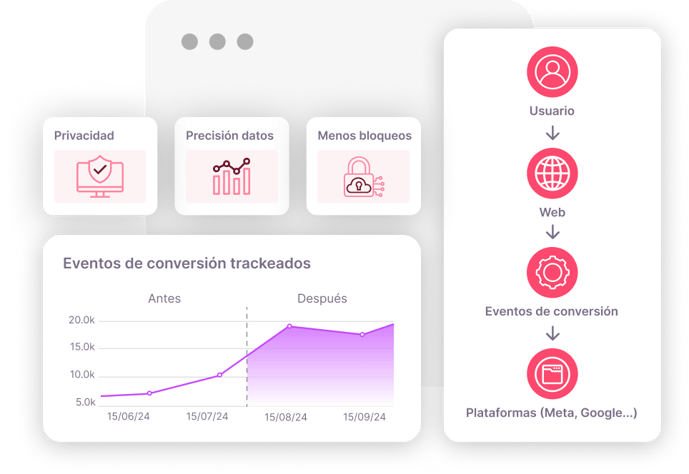

The result:
- ✅ More control
- 🚫 Fewer blocks
- 📶 Stronger signal
- 🔒 More private and resilient measurement
Is it the same as CAPI?
In practice, they share the same goal, but technically they solve the problem in different ways.
Both Meta/TikTok’s CAPI and Google Tag Gateway aim to recover signal lost in the browser and improve measurement quality using first-party data. That parallel helps to understand them quickly.
However, from a technical perspective, they are not equivalent:
- CAPI is a server-to-server implementation: your server sends events directly to the platform, without relying on the browser.
- Google Tag Gateway does not change where events originate. What it changes is the domain from which the tag is served and requested, turning that communication into first-party.
That’s why it makes more sense to see them as complementary rather than interchangeable solutions. In fact, Google recommends, as a next step, sending Google Ads events server-side as well, which would be the functional equivalent of a CAPI.
How do you activate Google Tag Gateway?
Activation depends on the CDN serving your website:
- One-click integration: if you use Cloudflare, Akamai, or Fastly, Google provides direct integration. From the corresponding settings, you authorize the connection with your CDN, and routing is activated without additional development.
- Manual configuration: with other CDNs, implementation requires additional routing and header configuration. It’s still a lightweight deployment but involves manual steps.
In both cases, a validation phase is essential: ensuring requests are correctly served through your domain, events are received as expected, and there are no regressions in existing measurement.
Google Tag Gateway + Enhanced Conversions: the combination that makes sense
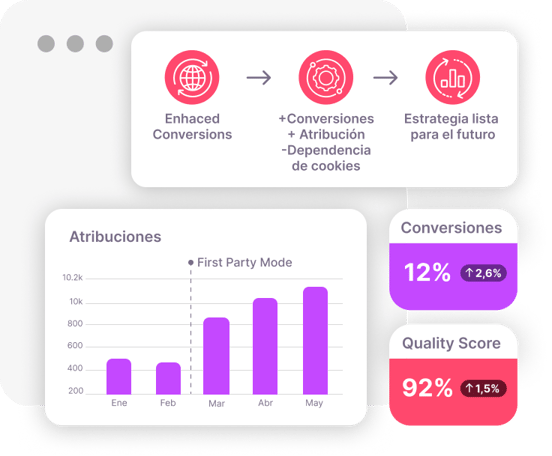
At this point, if you’re investing in Google Ads, enhanced conversions should already be part of your baseline setup. They are the current standard for enriching conversion events with user-provided data (email, phone, etc.) in a hashed and secure way, improving matching quality in Google Ads.
What matters here is how they interact with Google Tag Gateway. An enhanced conversion still needs to travel from the browser to Google, and it’s precisely during that journey where signals are lost due to blockers, cookie restrictions, or browser limitations. Google Tag Gateway ensures that this transmission happens through a first-party channel, so the enhanced conversions you already have in place arrive in greater volume and with more consistency.
In other words: Google Tag Gateway does not replace or duplicate enhanced conversions. It makes them more effective.
Google Tag Gateway and Adsmurai One Tag: how they fit together
If I’m already using Adsmurai One Tag, do I still need Google Tag Gateway? The answer is yes — and they complement each other perfectly.
They are different solutions solving different problems:
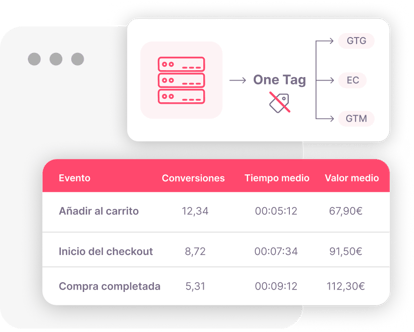
- Adsmurai One Tag is the server-side infrastructure we build and maintain for our clients to manage integrations such as Meta CAPI, TikTok Events API, and increasingly server-side delivery to Google Ads. It centralizes maintenance and reduces the costs associated with running these architectures on proprietary servers.
- Google Tag Gateway does not rely on a server: it’s an integration between Google and your CDN to serve Google tags from your own domain.
In fact, Google currently recommends complementing Tag Gateway with a server-side architecture for Google Ads. This is where Adsmurai One Tag adds value: it can host that server-side delivery alongside other integrations (Meta, TikTok, etc.) within the same infrastructure we already manage for the client.
Put simply: Google Tag Gateway and One Tag don’t compete — they reinforce each other.
Where should you start?
If you’re investing significantly in Google Ads and noticing that observed conversions are drifting away from real ones, or if your CDN is already Cloudflare, Akamai, or Fastly and you’re not leveraging this integration, it’s worth evaluating a deployment.
From our Data team, we support the entire process: technical audit, implementation via Google Tag Manager, CDN integration, and full validation of measurement before closing the project. Typical implementation timelines range between 1 and 2 weeks once access and technical requirements are in place.
If you’d like us to review your current setup and define the most effective signal architecture for your case, get in touch.