
zFor more than a decade, e-commerce has been dominated by a clear logic: whoever controls product search controls the sale. Under this premise, marketplaces consolidated themselves as the main entry point to digital commerce.
However, the emergence of AI Commerce is beginning to transform that model.
Today we are no longer talking about a simple technological trend. We are witnessing a profound reconfiguration of power in digital commerce.
Many describe it as the “battle of the century” between marketplaces and AI commerce. But the reality is more complex: we are not facing a direct substitution, but rather a metamorphosis of the purchasing process.
TABLA DE CONTENIDOS
- The paradigm shift: from Search & Scroll to Ask & Act
- The real battle: who controls discovery
- Los movimientos estratégicos que ya estamos viendo
- El gran riesgo para los marketplaces
- El futuro más probable: coexistencia
How marketplaces dominated digital commerce
Historically, platforms such as Amazon (global retail and marketplace), Alibaba (e-commerce and logistics across Asia), or Mercado Libre (ecommerce and fintech in Latin America) won the ecommerce battle for a simple reason: they were the best product search engines.
Their value proposition was built on four key pillars:
- Integrated logistics
- Trust built through reviews
- Fast price comparison
- Increasingly faster delivery
Thanks to these structural advantages, marketplaces captured a large share of high-intent traffic: users who already knew they wanted to buy.
For example, when someone searches for “Nike men’s running shoes”, the most likely outcome is that they end up directly on Amazon or another marketplace.
But that model is starting to change.
The paradigm shift: from Search & Scroll to Ask & Act
AI Commerce is introducing a new user interface for shopping. While traditional marketplaces operate under the Search & Scroll model, AI-driven commerce is evolving toward an Ask & Act model.
Traditional marketplaces
The user:
- types a keyword
- receives a list of results
- browses through dozens of options
- compares reviews and prices
AI Commerce (Agentic Commerce)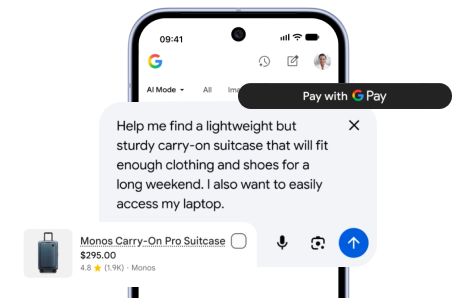
The user simply explains their need. For example:
"I need a backpack for a three-day trip to the Alps that fits in the Ryanair cabin and matches my blue jacket."
The AI assistant:
- filters products
- compares features
- analyzes reviews
- evaluates prices
- delivers a final recommendation
The difference is fundamental: AI doesn’t show a list, it delivers a solution.
Marketplaces vs AI Commerce: two purchasing models
|
Feature |
Marketplaces (Modelo2020-2024) |
AI Commerce (Model 2026) |
|
Discovery |
Based on SEO and paid advertising |
Based on AEO (Answer Engine Optimization) |
|
Decision |
The user compares products and reviews |
The agent synthesizes information and recommends |
|
Fidelidad |
To the platform (Prime, Meli+) |
To the personal assistant (ChatGPT, Gemini) |
|
Transaction |
Manual checkout |
Zero-click commerce via API |
This shift implies that the purchasing interface is no longer a website, but a conversation.
The real shift: from search to recommendation
For years, the purchase funnel remained relatively stable:
Search → Marketplace → Purchase
With the arrival of AI assistants, that flow begins to transform:
AI recommendation → brand / retailer / marketplace → purchase
In this new model, AI acts as:
- product curator
- shopping advisor
- transactional interface
And this gives rise to a new concept: AI Commerce
The real battle: who controls discovery
More than a war between marketplaces and AI Commerce, the real competition lies in who controls the recommendation layer.
Three actors are competing for that space: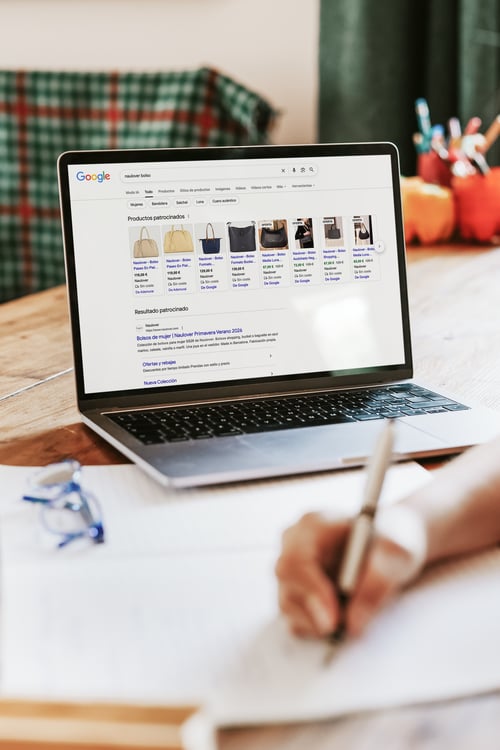
AI platforms: ChatGPT (OpenAI’s conversational AI), Perplexity (AI answer engine), and Gemini (Google’s AI).
Search engines: Google is integrating AI into discovery through AI Overview and generative shopping experiences.
Marketplaces: Amazon and Shopify are incorporating AI directly into their platforms to maintain control of the purchasing process.
Whoever controls this layer will have influence over:
- product visibility
- purchase decisions
- digital advertising investment
Strategic moves we are already seeing
In reality, the market is evolving toward convergence.
Marketplaces are becoming AI
Amazon and Shopify are no longer just online stores.
They are evolving into infrastructures connected with AI agents.
Some platforms are already exploring protocols such as the Universal Commerce Protocol, designed so that AI assistants can purchase directly within their systems without the user entering the website.
AI is becoming a marketplace
At the same time, tools such as ChatGPT or Perplexity are no longer limited to providing information.
They are starting to integrate:
- product recommendations
- automated comparisons
- “Buy now” buttons
- payment and delivery integrations
This is bringing the shopping experience closer to a conversational and automated model.
The major risk for marketplaces
Marketplaces will probably not disappear, but they do face an important risk: losing the moment of discovery.
If users stop entering Amazon to search for products and instead consult their AI assistant, the marketplace risks becoming simply:
- a logistics operator
- an inventory provider
- a fulfillment infrastructure
This is where an interesting transformation emerges.
If discovery begins to happen outside the marketplace, the role of one of its major revenue engines also evolves: advertising within the platform, known as Retail Media.
Until now, its strength has been concentrating the decision-making moment within the marketplace itself. But if that moment begins earlier — within AI assistants, conversational search engines, or automated recommendations — the strategic value of the marketplace is redefined.
Rather than disappearing, Retail Media will need to integrate into a broader discovery ecosystem, where inspiration, recommendation, and conversion can happen across multiple points in the customer journey.
For marketplaces, this opens the door to new ways of connecting data, inventory, and purchasing experiences within this new context.
The most likely future: coexistence
The most realistic scenario is not the disappearance of marketplaces. It is a division of roles:
AI → discovery layer
Marketplaces → transactional and logistics layer
Visually, the new model might look like this:
AI assistant
↓
product recommendation
↓
marketplace / retailer
↓
logistics and delivery
What this means for brands
For brands, this shift introduces a new strategic challenge.
If purchase decisions pass through AI, the key question will no longer be just how to rank in search engines or marketplaces, but rather:
How do you get an AI to recommend your product?
This opens a new field within digital marketing:
- AI discoverability
- Answer Engine Optimization (AEO)
- content optimization for LLMs
- new retail media formats within AI environments
In this context, the competitive advantage will not be advertising investment alone.
The winning brand will be the one whose data — catalogs, attributes, reviews, and content — are so clean, structured, and accessible that AI systems prioritize them by default.
Conclusion
The Marketplaces vs AI Commerce debate is fascinating, but it may be framed incorrectly.
We are not facing a life-or-death battle. We are witnessing a transformation of the purchasing funnel.
Marketplaces will remain essential for transactions and logistics, but AI may become the new gatekeeper of discovery.
And in this new scenario, the key question will no longer be where the user buys.
It will be who decides which product deserves to be bought.