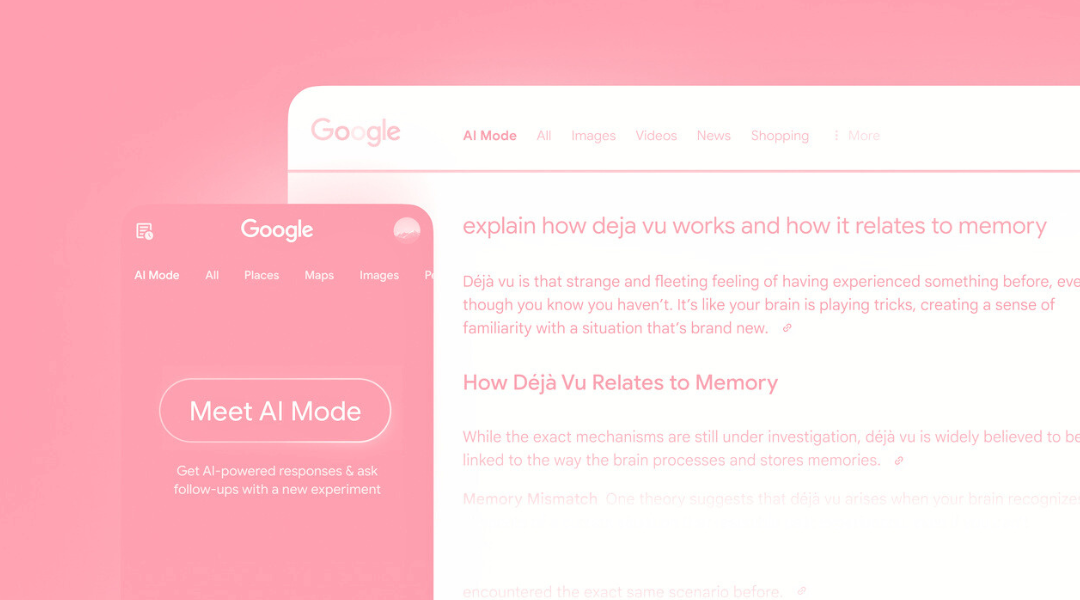
Until now, we searched.
Now, Google thinks for us.
The so-called Modo IA or AI Mode has just landed in Spanish. Yes, it’s official: Google has launched in Spain the most advanced version of its search engine one that doesn’t just find answers… it creates them.
This is the next step in the evolution of the search engine: a layer of artificial intelligence that responds, summarizes, and reasons instead of merely listing links. In other words: Google no longer just tells you where to find the answer it gives it to you directly.
And for brands, media, and advertisers, this is no small change.
TABLE OF CONTENTS
- AI Mode Arrives in Spain
- What This Means for Marketing (and Why You Shouldn’t Panic)
- How Brands Can Adapt (and What We’re Doing at Adsmurai)
From Search Engine to Brain: What AI Mode Does
AI Mode is an entirely new experience within Google Search.
Instead of showing a traditional SERP, the system generates an AI-written answer that blends information from different sources, images, videos, and even related queries.
The most interesting — and perhaps unsettling — part is that you can hold a conversation with the search engine: ask for clarification, add context, or even show it an image to help it understand what you mean.
In short:
We’ve gone from typing a keyword to having a chat with Google.
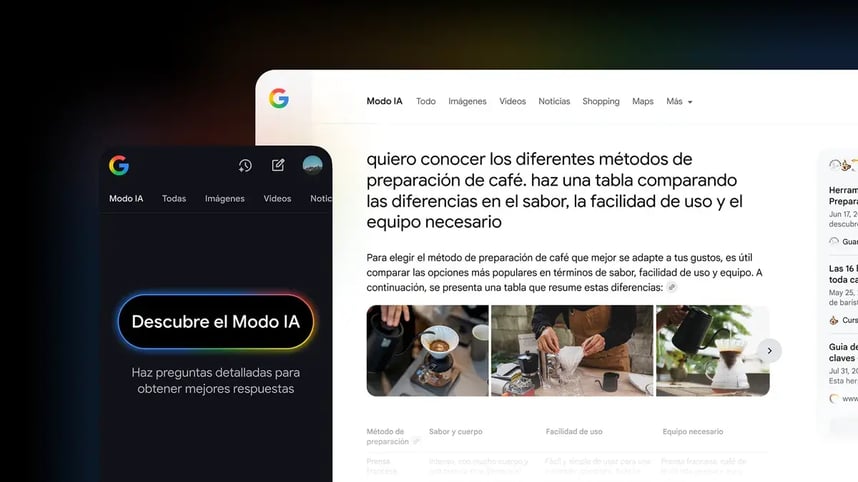
(Source: Google)
AI Mode Arrives in Spain
AI Mode is arriving as a new experience within Search. Instead of simply displaying a list of links, the system generates a conversational summary, written with the Gemini 2.5 model, combining information from multiple sources.
“AI Mode allows you to ask more complex questions, explore topics faster, and gain a more complete view of what you’re looking for.”
— Official Google Spain Blog (October 2025)
The user can interact with Search through text, voice, or images, ask follow-up questions without losing context, and receive a reasoned answer (not just a link).
It appears as a new tab or button within the search page, both on desktop and mobile, and according to Google, early users are already asking queries that are 300% longer than traditional searches.
Yes, Google confirms it: we’re moving from searching to conversing.
In short: Google is no longer a search engine — it’s becoming a cognitive assistant.
How It Works (and Why It Changes the Game)
AI Mode uses a technique called query fan-out, which breaks your question into subtopics, searches for relevant information, and then generates a synthesized answer.
If the AI isn’t confident enough in its response, Google falls back to traditional results.
According to the company itself:
- Clicks that do occur tend to be distributed across a wider range of websites (not just the top results).
- Users who click after an AI response spend more time on the sites they visit.
- The experience is multimodal: you can ask by voice, upload a photo, or even continue a previous conversation.
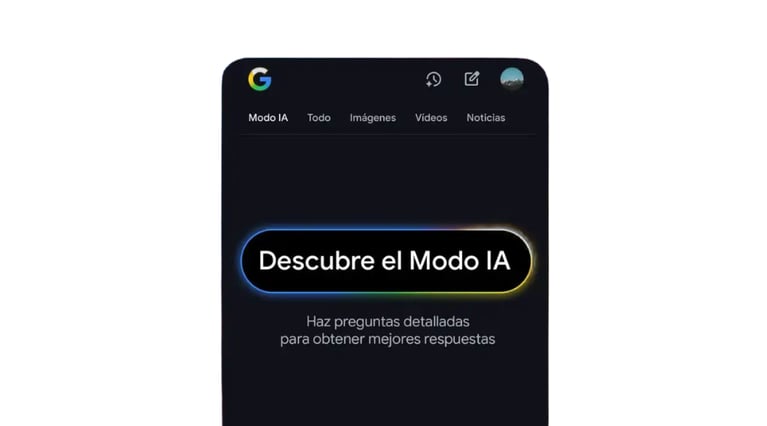
(Source: Google)
What This Means for Marketing (and Why You Shouldn’t Panic)
Let’s get to the point:
What happens when the world’s biggest source of organic traffic decides not to send traffic anymore?
Yes, that’s the uncomfortable part.
If Google already answers with its own generated content, clicks to your website may drop.
🔻 The Challenges
- Fewer clicks, more uncertainty
The AI gives full answers. Many users won’t visit your site, which will affect organic traffic — especially informational content. - Less control over your message
Google decides which parts of your content it uses to build its answers. Without authority or structure, you might “not exist” in the summary. - Goodbye to shortcut SEO
Generic articles written just to rank are on borrowed time. AI values quality, not quantity.
🔼 The Opportunities
- AI-friendly content
Structure your texts so AI can understand, cite, and use them. That means clear answers, reliable sources, concrete data, and clean formatting. - Authority over volume
The battle is no longer about keywords but about thematic relevance. Specialist brands win; generalist ones disappear. - More qualified traffic
Even if clicks decrease, those who do arrive will have gone through a “pre-education” process via AI — meaning they’re more ready to convert. - New ad formats
Google won’t abandon ads — it will integrate them into the AI flow. That opens up a new layer of conversational search ads where relevance is everything.
How Brands Can Adapt (and What We’re Doing at Adsmurai)
At Adsmurai, we’ve been preparing for this shift.
We’ve already lived through similar transitions: from “free organic reach” to dynamic feeds, from the pixel to first-party data, from static reporting to real-time dashboards.
Now, it’s the era of AI-interpreted content.
Some practical steps we recommend to our partners:
- Audit your existing content: identify which articles or landing pages could be “citable” by AI and optimize them for E-E-A-T (Experience, Expertise, Authoritativeness, Trustworthiness).
- Use AI to your advantage: tools like Brand Tracker already let you see if your brand appears in AI-generated responses (yes, it can be measured).
- Bet on specialized content: create materials that answer complex, not generic, questions.
- Protect your digital branding: even if there’s no click, having your brand visible in the summary is already valuable.
Google Becomes Copilot, Not Search Engine
AI Mode marks a new era where search becomes conversation.
Where brands compete not just to rank on a page but to be part of the search engine’s reasoning.
Yes, SEO as we knew it is changing.
But so did advertising with AdBlock, social media with algorithms, and e-commerce with one-click checkout.
And spoiler those who adapted, grew faster.
The question is no longer “how to rank on Google” but how to train the AI to mention you when it matters.
And believe us, a whole new game has just begun.